
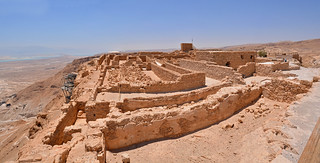
Masada!
Sobering Lessons to Learn
Richard Hollerman
Surely some of our readers know of the Jewish fortress built by Herod the Great called Masada. This Idumean “king” built (or enlarged) this “refuge” in three phases from the time that he began to reign in 37 BC until his death in 4 BC. Actually, the fortress continued to be built almost until it was used to fend off the Romans.
But what was Masada and what can we learn from it? As we know, the land of Israel is a desolate region of the world, containing the Dead Sea—the lowest place on earth. Also the Sea (or Lake) of Galilee, is also known to be below sea level.
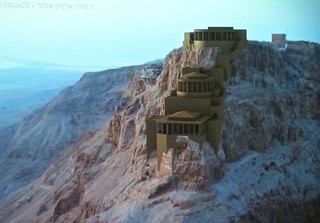
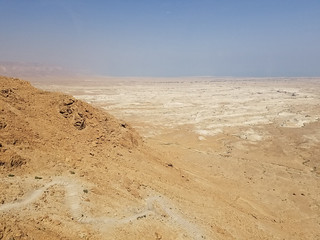
Herod was a paranoid and somewhat eccentric ruler. He knew that his subjects—the Jews—hated him and he sought to ensure that he had a place to escape if anyone attempted to capture him. This is why he chose Masada, a cliff dwelling, some 1,400 feet high above the surrounding terrain. The top of the rock was flat and measured 1,900 feet (579 meters) by 650 feet (198 meters). It can only be accessed from the east by means of the “Snake Path.” Herod knew that this place, located some 20 miles SE of Hebron, would be nearly impregnable to anyone who would attack him. In addition, this paranoid king built a 4 m (about 12 feet) high casemate wall around the top of the plateau.

We know that Herod was the wicked king who cruelly murdered all of the babies in Bethlehem two years and younger in about 6-4 BC (cf. Matthew 2:4-18), In his jealous attempt to prevent anyone else from claiming the crown Herod was enraged and committed such a wicked deed. Thankfully, he did not succeed in killing Jesus our Lord who escaped to Egypt until Herod’s death (in 4 BC, Matthew 2:19ff).
Herod was known for great building projects (for which he greatly taxed his subjects). He built Caesarea, the home of Cornelius (cf. Acts 10), along the Mediterranean. He also built Tiberius along the western edge of the Sea of Galilee. He further built Mchaerus (on the eastern part of the Dead Sea) where he killed John the baptizer. Most importantly, Herod greatly enlarged the Second Temple in Jerusalem. He began this massive building project but it was completed just before the Jewish revolt in AD 66-70. Masada was one of his chief projects even though, ironically, he never lived there!
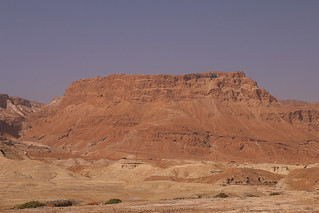
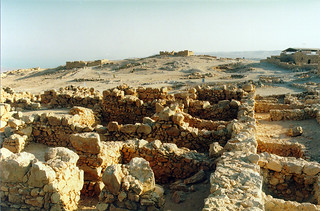
What was this fortress like? Not only was it nearly unapproachable and inaccessible, but Masada was built on the nearly flat surface on top of a mountain. During the many-year building project, he built a palace in three parts, a swimming pool, a synagogue, storehouses for food and supplies, cisterns for water (from rainwater), living quarters for families, and places for his soldiers to live. How could he do this in a place that receives only a minimal amount of rain each year? He knew that the little rain that does come (in the winter) could be collected into cisterns and these water-collections could accommodate thousands of gallons of water. There was sufficient to plant and irrigate food crops atop this mountain-fortress!
You may remember enough about the history of Israel to remember that the Zealots, in AD 66, rebelled against the occupying power of Rome. However, beginning at the north, the Romans destroyed one city or village after another in an effort to contain the rebellion. Finally, in AD 70, the Romans breached Jerusalem’s walls. There they found emaciated Jewish inhabitants who had fought against each other—and against the Roman Legion. Sadly, they set fire to the great Herodian temple, destroyed the dwelling places, and broke down the walls. Tradition has it that some one million Jews where slain and some 100,000 were taken back to Rome as slaves. (This is detailed on the Arch of Titus in Rome as well as the significant work by Josephus.)
However, there were some 960 Jewish rebels who escaped and continued their opposition. They headed for Masada where they killed Roman soldiers of the Tenth Legion. Thus, they eventually controlled Herod’s fortress and used this as their final dwelling place until the end would come. These “Sacarii” (dagger-bearers) even opposed the Zealots who had waged a war against their fellow-Jews for years, determined to withstand the whole Roman army. One report has this:
After the destruction of the Second Temple in 70 CD, additional members of the Sacarii fled Jerusalem and settled on the mountaintop after slaughtering the Roman garrison. According to Josephus, the Sacarii were an extremist Jewish splinter group antagonistic to a larger grouping of Jews referred to as the Zealots, who carried the main burden of the rebellion. Josephus said that the Sacarii raided nearby Jewish villages including Ein Gedi, where they massacred 700 women and children (enwikipedia.org/wiki/Masada).
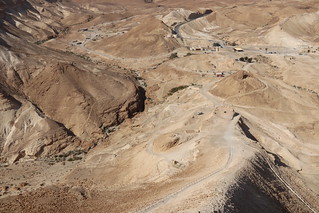
Silva, the Roman general, determined to totally wipe out these rebels. He commanded an army of about 8,000 to 9,000 men (a total of 15,000 people). With painstaking efforts, he constructed a great siege ramp on the face of the mountain to the west. Week by week and month the height increased until the Romans reached the top of the mountain. Herod’s walls that encircled the top could not withstand this onslaught. Finally, in April of AD 73, the Roman army reached the level top. What did they find when they entered the fortress?
According to Josephus, the Jewish historian, the Romans found some 970 dead Jews! According to the account, in order to prevent the Romans from killing the remaining rebel Jews, these made a pact by choosing lots. They thought that suicide was forbidden by God, thus they killed each other and the final man did kill himself. (Somehow they justified both suicide and murder as well as rebellion against the ruling civil powers!).
They knew that they could not withstand the massive Roman army, thus each father or head of the families would kill his own family. The final ten Jewish men then drew lots and the one who was chosen would kill nine and finally kill himself. All would be killed. (According to Josephus, two Jewish women and a few children survived, and they were the ones who related to the Romans what had happened.) One account says that the Romans then killed these few remaining informant Jews.
For some years, the government of Israel would bring their young men who had gone through Basic Training to this place. There they would be shown Masada and would be urged to stand strong and courageous, just as did these ancestors many years ago. “For many Israelis, this devotion to liberty is a national symbol called the ‘spirit of Masada.” (World Book Encyclopedia, Vol. 13, p. 262).
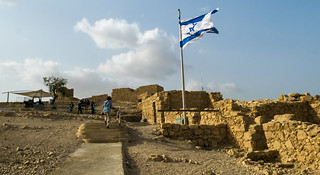
Moshe Dayan “initiated the practice of holding the swearing-in ceremony of Israeli Armoured Corps soldiers who had completed their tironut (IDF basic training) on top of Masada. The ceremony ended with the declaration: ‘Masada shall not fall again.’ The soldiers climbed the Snake Path at night and were sword in with torches lighting the background (en.wikipedia.org/wiki/Masada).
Anyone who reads of this interesting story will be struck with several prominent points. Jewish people often look at this account with pride. The Christian (the follower of Jesus Christ) knows that pride is a deed of the flesh that God condemns and will harshly judge (Mark 7:22-23). Further, it is interesting that these people killed each other and committed suicide. (They also murdered many others—Jews and Romans alike.) We know that murder (including self-murder) is another sin that God condemns and will send to the lake of fire—or hell (Revelation 21:8; 1 John 3:15).
Another point worthy of noting is that apparently every single one of these 970 men rejected Jesus as the Messiah, the Son of the Living God. We do know that those who do not believe or obey Christ Jesus “will not see life, but the wrath of God abides on him” (John 3:36). While they were loyal to Israel (as they understood such loyalty), they utterly rejected God Himself!
We could also observe that these rebels absolutely rejected Rome’s control over their country and refused to pay their taxes, a duty that Paul urges on followers of Christ (Romans 13:6-7). Further, boasting is another deed of the flesh that will result in God’s judgment (Romans 1:30). This is certainly a sin that many in Israel (and elsewhere) commit as they think of the defiant attitude of the defenders. Further, these rebels were known as “dagger-bearers” which shows their violent and vicious (as well as deceitful) nature!
As we continue to look at this historical event, we see a group of Jewish people (clearly, they were murderers, filled with pride, arrogance, deceitfulness, and wickedness) who were willing to endure great deprivations, manifest skill, and eventually were willing to murder and kill themselves. In contrast to Paul the apostle, who says that we are to submit ourselves to the governing powers (Romans 13:1-7), these people refused to obey these powers and demonstrated their unwillingness in a public way.
Whereas Scripture says that we are to “bless those who persecute you; bless and do not curse” (Romans 12:14), these rebels refused to bless and clearly “cursed” their enemies. God’s Word also warned, “Never pay back evil for evil to anyone” and “Never take your own revenge, beloved,” and “Do not be overcome by evil, but overcome evil with good” (Romans 12:17, 19, 21). All of this was a public display of defiance! Rather than face humiliation of defeat, they were willing to take the lives of others as well as themselves!

It is important that we not think of these men and women as poor defenders of liberty. One account says this:
“According to Josephus, the Sicarii were an extremist Jewish splinter group antagonistic to a larger grouping of Jews referred to as the Zealots, who carried the main burden of the rebellion. Josephus said that the Sicarii raided nearby Jewish villages including Ein Gedi, where they massacred 700 women and children.” (Wikipedia).
In other words, they were violent and hardened, determined to resist Rome in the name of God!
Here were rebels whom many modern Jewish people and others look to with pride and use this example as a means of urging us to be like them. But clearly, they disbelieved in Jesus the Messiah and refused to submit to Christ, the Son of the Living God, and the only way to God in heaven (John 14:6), the only Mediator between God and humanity (1 Timothy 2:5).
We can only look back on these people with deep sadness. We can allow this incident to encourage us to lay down our lives for Jesus and can use this account to stimulate us to reach people while we and they have the opportunity. We surely would not want to voice an appreciation or admiration of these misguided rebels, but we can determine to not fall into their footsteps of rebellion. Instead, we can be encouraged to touch the lives of Jewish people and all others lest we fall into this sort of fate. Jesus is the only way! We must believe this and must encourage others to accept this truth as well.
May God help us to learn about Masada and the lessons from this sad account of history.

Sources:
“Masada” The World Book Encyclopedia
“Masada” Wikipedia
Frommer’s “Israel” pp. 167-171
Fodor’s Travel Essential Israel, pp. 173-180
Jeffrey Geri and Marian Lebor, Israel, p. 18


 You can reach us via e-mail
at the following address:
You can reach us via e-mail
at the following address: