
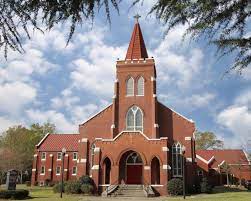
Why I Am Not a Lutheran
Richard Hollerman
Some of you may know that many years ago I departed from the Lutheran Church—which belonged to a very liberal denomination. (For example, I think it was after I left that this congregation employed a woman as their pastor!) Although this was a congregation within the American Lutheran Church (as it has come to be known), the same would be true of other Lutheran denominations. I refer to the many denominations in the nations of the world as well as in the United States.
Presently, there are some 80 million Lutherans in the world. Thus, it is not a small denomination at all. We read: “Lutheranism is present on all inhabited continents with an estimated 80 million adherents, out of which 74.2 million are affiliated with the Lutheran World Federation.”
(https://www.google.com/search?q=number+of+lutherans+in+the+world&oq=number+of+Luther&aqs=chrome.0.0j69i57j0j0i22i30l7.6304j0j15&sourceid=chrome&ie=UTF-8).
We read further: “it constitutes one of the largest Protestant branches claiming around 80 million out of 920 million protestants. The Lutheran World Federation brings together the vast majority of Lutherans. Apart from it, there are also other organisations such as the International Lutheran Council and the Confessional Evangelical Lutheran Conference, as well as multiple independent Lutheran denominations.”
A further reading that helps us to understand more fully the worldwide Lutheran denomination would be: “Today, almost half of Lutherans are living in Europe. Germany accounts for one-third of European Lutherans and one-eighth of the world’s Lutheran population. Most of the remaining European Lutherans are confined to the Nordic countries and the Netherlands. United States accounts for one-eighth of the world’s Lutheran population, but only around 4 million of them are members in the Lutheran World Federation. It has most Lutherans in North America. Ethiopia and Tanzania have the largest Lutheran populations in Africa, while Indonesia and India—in Asia. Papua New Guinea has most Lutherans in Oceania, and Brazil—in South America.”
(https://en.wikipedia.org/wiki/Lutheranism_by_region#:~:text=Lutheranism%20is%20present%20on%20all,with%20the%20Lutheran%20World%20Federation).
A further way to understand the membership would be to discover the number in each continent. We find this:
By continent
Continent Lutherans
Europe 33,733,309
Africa 24,135,469
Asia 11,376,400
North America 3,672,858
South America & the Caribbean 768,589
Total 73,686,625
https://en.wikipedia.org/wiki/Evangelical_Lutheran_Church_in_America
In light of this, are we to assume that some 73 million people meet together as a church three times a week? Not at all. Do we really think that 73 million Lutheran members even meet together once a week? Again, not at all. Many Lutherans don’t meet together at all and many only occasionally come together as a church. It can be safely said that many or most Lutheran members are not devoted, zealous, or committed to gathering together as a body (cf. Hebrews 10:23-25). Sadly, we think that most are not even committed to each other. Many just meet together occasionally.
We all know that the membership of this denomination has been slowly decreasing over the years, but it is still a viable church and must be condemned on many counts. Thus, although it has been years since I departed, I remain in opposition against the beliefs and lifestyle of this liberal and “tolerant” denomination. Why? Basically, because I believe in the truth of Scripture which I take to be the Word of the living God.
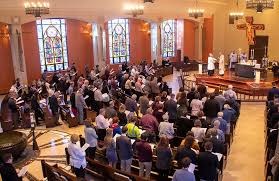
Before we go further, let’s discuss the number of Lutherans in the United States:
The Evangelical Lutheran Church in America (ELCA) is a mainline Protestant Lutheran church headquartered in Chicago, Illinois. The ELCA was officially formed on January 1, 1988, by the merging of three Lutheran church bodies. As of 2019, it has approximately 3.3 million baptized members in 8,972 congregations.
In 2015, Pew Research estimated that 1.4 percent of the U.S. population self-identifies with the ELCA. It is the seventh-largest Christian denomination by reported membership, and the largest Lutheran denomination in the United States. The next two largest Lutheran denominations are the Lutheran Church–Missouri Synod (LCMS) (with approximately 2.0 million members) and the Wisconsin Evangelical Lutheran Synod (WELS) (with approximately 350,000 members). There are also many smaller Lutheran church bodies in the United States, some of which were formed by dissidents to the major 1988 merger.
https://en.wikipedia.org/wiki/Evangelical_Lutheran_Church_in_America
We know that many people these days prefer to speak of this as a “progressive” denomination but we prefer to speak the truth about this group and others as well. In other words, it is a liberal and anti-Christian denomination and not just “progressive”—which could be interpreted in a positive light. It just may be that some people like the description of being “progressive” even though it may be interpreted as a very bad term—progressive in the sense that many “progress” beyond Scripture.
Why would we say this? The Lutheran Church (whether we refer to the Missouri Synod Lutheran or we speak of the largest Lutheran denomination in the United States) has become quite unbiblical it stance. It has been liberal for centuries but it continues with this perspective. Let’s just mention a few of the reasons for our opposition.
- The Lutheran Church has an unscriptural name. It is named after a human being (Martin Luther) rather being “named” after Christ. Of course, this is entirely wrong—and sinful. Actually, the body of Christ has no official name, according to Scripture (see 1 Corinthians 1:10-13).
- The Lutheran Church is ruled by Bishops or other non-Biblical leaders. However, in Scripture, the leadership of each congregation is known as the overseer (KJV, bishop) or elders or shepherds (KJV, pastors) (Ephesians 4:11; Acts 20:17, 28; 1 Timothy 3:1-2; Titus 1:5-7; etc.).There is no such thing as a bishop that supervises multiple congregations.
- The Lutheran Church has extra-biblical organization. In the New Testament, each assembly was independent, whereas the Lutheran Church has a nation-wide organization—and even a worldwide organization.
- The Lutheran Church “baptizes” babies whereas the early assembly baptized believers alone (Acts 2:38; 8:12; etc.). We are aware that there are other churches or denominations that also pour or sprinkle babies (such as the Methodist Church, the Episcopal Church, the Anglican Church, the United Church of Christ, and others) but this does not make this unscriptural practice right.
- Further, the Lutheran Church pours water on the baby, whereas the early body of Christ immersed believers in their coming to Christ (Romans 5:3-5; Colossians 2:11-13; Acts 8:38-39; cf. Matthew 3:16). Please read our articles on this in our website.
- The Lutheran Church has a child or adult go through a confirmation ceremony, whereas confirmation was unknown to the early Christians. This is one of the outcomes of infant baptism, itself an unscriptural ceremony (cf. Matthew 28:18-19; Mark 16:15-16; Acts 2:38; 8:12, 35-39).
- The Lutheran Church believes in a man-devised system of salvation whereas the Bible says that one must repent of his sins (Acts 2:38; 3:19; 20,21), confess Jesus as Lord (Romans 10:9-10), and be immersed into Christ (Romans 6:3-5; Matthew 28:18-20), in obedience to the so-called “Great Commission” to be saved. A believer is to believe in Christ to be saved, something that babies cannot do.
- The Lutheran Church believes in “baptismal regeneration” which means that by means of “baptism” of whatever kind, the teaching is that the child is actually forgiven, regenerated, saved, given the Holy Spirit, and becomes part of the body of Christ, whereas in the early assembly of the Lord, God forgave a repentant believer through Christ.
- There are different answers to this matter, but some Lutheran Churches have the “Lord’s supper” each first day of the week (which is accurate) whereas some churches refuse to have this frequency (cf. Acts 20:7). They have some sort of ceremony once a month, or even once a year.
- The Lutheran Church believes in adiaphora. These are “practices of the church that were neither commanded nor forbidden in Scripture.” They are “those things not clearly addressed by Scripture that Christians may freely practice or believe with a clear conscience before God and that do not affect salvation” (Pocket Dictionary of Theological Terms, Stanley J. Grenz, et.al). Thus, many practices are found in the Lutheran Church or promoted by the same which are not Biblical.
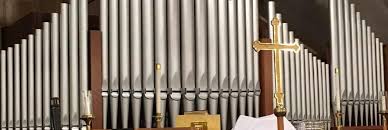
- The Lutheran Church promotes the use of various ritualistic and formalistic elements. Why are there Lutheran pastors? Why do Lutherans need to go to seminary? Why do Lutheran leadership and laity wear elaborate clothing? Why do Lutherans use a formalistic liturgy in their services? These are a few of the many questions we may ask regarding “churchianity” that is “alive and well” within Lutheranism!
- Lutherans employ and promote the use of women publicly, whereas the Bible flatly condemns such a practice (cf. 1 Timothy 2:11-15; 1 Corinthians 14:33-37; Titus 1:3-5; 1 Timothy 3:1-5). In the Scriptures, only men (males) are permitted to assume leadership roles. Women are to remain silent in the assembly. (Further, women are not to have leadership over the men (husbands, or others) for this is utterly condemned in God’s Word. Sadly, in many Lutheran Churches, feminism is dominant. Women may actually become the local pastor or the national leader!
- Of course, Scripture would say that we are to live a quiet, sobering, plain life without elaborate clothes and jewelry and other such things. Obviously, Lutheranism (along with most other Protestants, Catholics, and similar professing “Christians”) seem to know nothing about this (see 1 Timothy 2:9-10; 1 Peter 3:1-4, etc.)
We know that there are dozens of different elements found within the various Lutheran bodies that are unscriptural but they are accepted by the membership. We refer to such things as religious holidays, denominational membership, Lutheran leadership, and so forth.
You may wonder how important all of this may be. Consider this: If God wants a child to be taught the ways of God but the church “baptizes” the child, that child will probably grow up in the church, assuming that he or she is a Christian, whereas in God’s sight, such a person is still without genuine baptism and is lost! Does this sound like a small thing to you? In reality, it may keep a person out of heaven! Maybe this describes you! We must warn Lutherans that they are condemning their children to hell!
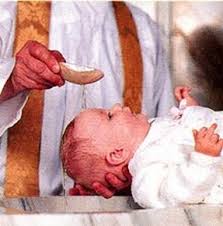
Or if a child is taught that pouring water on a head of someone is baptism but, in reality, baptism is an immersion in water, then that person may go to his or her grave thinking that he or she has been saved but is not been! The person may assume that he is “baptized” but, in reality, such a person has not been baptized (immersed) at all!
Obviously, this could go on and on but hopefully you can see that this is a serious matter. It demands your attention! I urge you very strongly to renounce all of this false doctrine and all of these false practices and truly come to Christ for His forgiveness while you may!
Are you reading this as a devoted member of the Lutheran Church? We grant you that you may be finding fellowship within this group and may find some degree of acceptance. You may feel like this is a church that is to be promoted. In reality, I hope that we have shared enough with you that you now can see that the various Lutheran denominations are far, far from the truth of Scripture.
It may be true that the Lutheran Church, Missouri Synod, and the Lutheran Church, Wisconsin Synod, are confessional groups and doctrinally they may have escaped some of the negatives associated with this denomination; however, as our discussion above has made clear, this church yet is far from God’s will and must be soundly rejected by those who value the will of the Lord.


 You can reach us via e-mail
at the following address:
You can reach us via e-mail
at the following address: