
Richard Hollerman
We know that some people have heard of Vivek but know him regarding only that he is a conservative Republican from India. He is a former pharmaceutical executive and executive. He is now worth about one billion dollars in America, making him one of the 20 youngest billionaires in the country.
Many people know him only as a conservative front runner for the presidency, but know little of his Hindu faith. Vivek holds to the Indian belief of Hinduism, believing in 330 million different gods. Yes, he is conservative and is a Republican and also is a ethical person (according to reports), objecting to killing babies (abortion), women’s leadership (or feminism), objecting to “climate change,” objecting to an “open border,” and thinking that sex outside of marriage is wrong. This is why conservative Republicans love him and liberal Democrats hate him.
But what else do we know about his beliefs? (https://news.yahoo.com/who-is-vivek-ramaswamy-a-rising-gop-candidate-in-the-2024-presidential-race-).
He is a Hindu but was raised by Catholics. According to what I’ve read, Ramaswamy came from India’s elite Brahmin class. Also, from what we have read, this is additional information:
Ramaswamy is fervently against the government doing anything to stop climate change. He has called for the U.S. military to be deployed to the border with Mexico in order to halt the flow of migrants. He opposes more aid to Ukraine and wants a federal ban on abortion after six weeks of pregnancy. [Ibid.]
When it comes to the differences between Ramaswamy and Christianity, “the difference between Christianity and Hinduism is a difference in cosmology. Hinduism tends toward a belief in an eternal Universe which is monistic and divine. Christianity believes in a single, eternal God who created a material Universe giving it a beginning, a purpose and a destiny.”
We read further: “For Hindus, Christ is an acharya. His example is a light to any of us in this world who want to take up the serious practice of spiritual life. His message is no different from the message preached in another time and place by Lord Krishna and Lord Chaitanya.”
This definition and explanation surely was written by a “layman” and it is very
. For those who wish to know more about this false religion, we offer the following. We may find a more complete but still a defective comparison with these words:
Hinduism
The word Hindu comes from the original word for the country of India. It means one who comes from India. Since the religion is so fundamental to that geographic area, the people and the religion often carry the same name. However, in modern usage the term Hindu and Hinduism refer to religion and not the nation.
Hinduism is the oldest “organized” religion in the world still in existence today. It is complex and dates back to a period around 1500-2000 BC (i.e. Judaism – 1400 BC). It is a religion that is confined almost exclusively to India and finds its roots in the social, geographical and primitive religions of this country. [Note, if Noah lived in 2450 BC, we would think that the dates that he give, perhaps AD 1500 to 2000 BC, might be somewhat early.
Founder
There is no one founder of Hinduism, it evolved as the thinking, practices and influences of its geography and society affected the people of that region and their reaction to it in both physical and spiritual ways. It began as a nature religion similar to those we looked at when reviewing primitive religions.
Origins
The formulation of the Hindu religion began as a “priesthood” arose to serve as the mediators of the natural and supernatural elements worshiped by the people. This rise of a special class of individuals gave birth to a stratification of their social system which continues to exist to this day, and which is the most important element of the religion and the society in which it is practiced.
With time there developed four stratas or castes within Indian society:
Brahman: Priestly caste, philosophers, the highest social position. Guardians of social heritage.
Kshatriya: Warriors, lords. Today, the politicians, bureaucrats and military leaders. Rajah=Ruler / Maharajah=Great Ruler.
Vaisyas: Commercial class, business people. Middle class.
Sudras: Artisans, blue-collar workers.
Out Caste: Beggars, those who belong to no caste. Not even considered as existing.
These four castes are divided into thousands of substructures but several things remain sure:
No intermarrying between castes.
No changing of castes regardless of wealth.
Everybody agrees to this from top to bottom.
Many ask why this system has continued into the modern era. The answer is that the continued practice of the Hindu religion is the major reason why this social stratification remains.
Deity
Brahma, a pure spirit and ultimate life power of the universe. Brahma does not have personality or being. Hindus do not pray to Brahma. Brahma gives life to lesser gods who in turn create and operate in the world.
Mankind (concepts)
Atman: The condition of the true self which is the perfect harmony between the soul and the physical self.
Maya: The idea that the entire world is only an illusion. The purpose of religion is to detach oneself from this illusion.
Caste: This is a divine system not to be tampered with. Of course these ideas developed throughout centuries of life in difficult social and geographical conditions. The Hindu religion is a case of people adapting their religion to fit their suffering. A religion that justifies the inequalities of life and offers “detachment” as the only hope. In doing so it maintains social order and offers a type of hope.
Salvation
Moksha (merging). This is the objective of all life and the Hindu concept of salvation. Moksha is when the soul of man “merges” or becomes one with Brahma. The result is freedom from this world and unconscious oblivion.
Moksha is accomplished in various ways:
Karma-Marga (The Way of Works): Performing good deeds and devotional service like temple worship. Avoiding bad “karma.” Hindus believe that good and evil deeds move you ahead or pull you back from moksha (merging). The evil done encrusts on your soul and slows the journey towards moksha, therefore, bad karma is to be avoided.
Jnana-Marga (The Way of Knowledge): Through the acquisition of knowledge there may be a sudden insight that instantly produces moksha.
Bhakti-Marga (The Way of Devotion): Moksha through emotional experience, ritualistic dances, ecstatic experiences (e.g. Pentecostals in the Christian Religion). Yoga is the exercise used to achieve the release of moksha.
Cultus
Worship is directly related to obtaining moksha. Temple worship, yoga, readings for knowledge, all done to achieve moksha.
Scriptures
Several works have been developed over the centuries. Hinduism does not rest its authority on divine revelation.
Brahmanas: Religious ceremonies. Mantras are those portions dealing with chants written in Sanskrit between 1000-700 BC.
Aranyakas: Folk wisdom, mythology.
Upanishads: Philosophical books.
Bhagavad Gita: Talks about Krishna who was one of the three lesser gods under Brahma. With the arrival of Christianity this god was fashioned by Hindu writers in the style and work of Jesus Christ. You can be a Hindu and believe in Jesus as well. In Hinduism the more gods you have, the better your chances for moksha.
“12. Never have I not been, never hast thou and never have these princes of men not been; and never shall time yet come when we shall not be. 13. As the body’s tenant goes through childhood and manhood and old age in this body, so does it pass to other bodies; the wise man is not confounded therein.” -The Bhagavad-Gita
Laws of Manu: (250 BC) An attempt to codify Hindu laws and commands.
Vedas: The oldest of the books (2000 BC), poetry, musings about the primitive Hindu faith.
Geography
India, however it influenced religions that sprang from it to other countries (i.e. Buddhism).
Miscellaneous
Reincarnation is a basic belief of Hinduism. It is the concept that the soul continues to migrate through the creation until it reaches moksha. One could reincarnate as someone in another caste (craftsman or priest) or go down to the out caste (for bad karma). This reincarnation happens until moksha takes place. This is why Hindus do not change the system, because to do so is futile, it will not help in the attainment of moksha. According to the Hindu religion cows are sacred because they represent the final step before reaching moksha. To kill one would be to deny a soul entering moksha.
The “dot” on women’s foreheads is called a “bindi.” It is usually red in color and normally worn by married women. It is placed on the forehead between the eyebrows because Hindus believe that this is the focal point for wisdom and where the body’s energy is concentrated.
The Hindu greeting is called the “namaste.” The word means to greet. It is a non-verbal way to say good day as well as a non-contact form of greeting. When the hands are put to the forehead it is a gesture of worship. In the Hindu religion the namaste is a way of saying “the spirit in me respects the spirit in you”. Usually, the younger person initiates this gesture before an older person as a sign of respect.
We can see that this is widely different from the truth of God. God has much to say about life, death and salvation. And most people will be separated from the Lord and everyone may find His salvation through Christ alone—and not through a Hindu deity. So although Hinduism is old, very old, and not as old as this person believes, it still represents the lie of the enemy of our soul and only Christ can deliver us, by His grace and power.
Thus, we must say that Hinduism (the religion of India), although it is quite old, it is false and untrue. It conflicts with the truth of Scripture and with the reality that comes from it. Thus, sadly, we must say that Vivek Ramaswamy is false the his religion is utterly false.
We say this for various reasons:
- First, we know that there is one and only one God and not 330 million of them!
- The Scriptures are true (and they were written before Christ) rather than the Bhagavad Gita, the Vedas, and other Hindu Scriptures.
- Hindus have done horrible things over the years which history tells us in graphic detail.
- The caste system (dividing people into at least five different groups) would be wrong and unjust.
- Many of the tales and myths of Hinduism are wrong and false.
- Reincarnation (which Hinduism is based on) is faulty and a lie.
- This religion has murdered many victims, including those who claim to be Christians.
- When one dies without God and apart from Christ, he will go to his unending destiny of hell (where he will be without Christ and His hope) (we encourage you to read Matthew 25:46 and 2 Thessalonians 1:7-10).
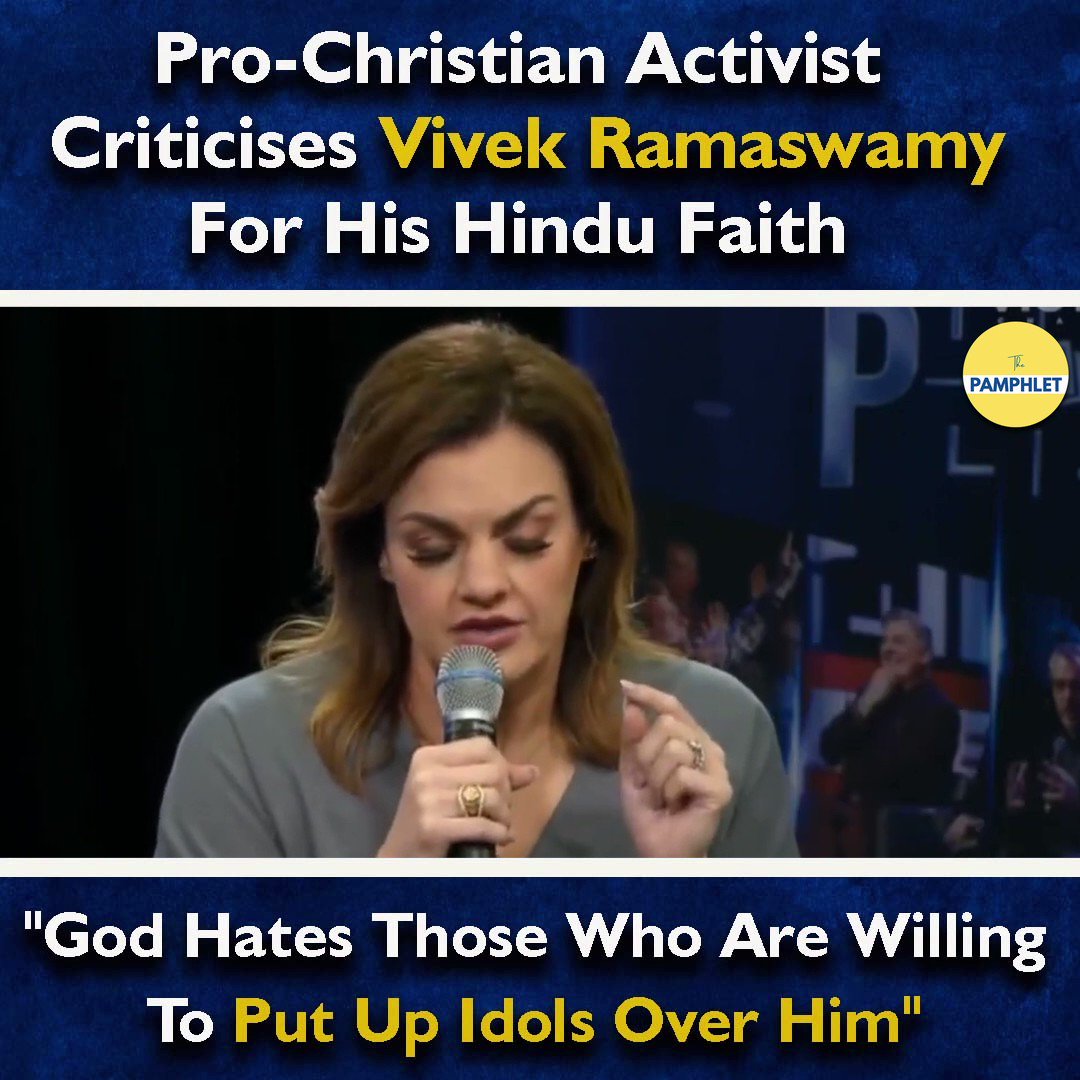
(Obviously, we would not agree with this woman’s feminism, according to 1 Timothy 3:11-15; 1 Corinthians 14:33-37, and many other passages, but her opposition to Vivek’s religion is well-taken!)
For these reasons, we must say that Vivek Ramaswamy is wrong and his religion is faulty. Although Hinduism that he represents may have certain good qualities, it is wrong. Further, he says that he stands for certain qualities or features that endear him to conservative Republicans, such as:
- For a limited government
- Against killing babies (abortion)
- For a “border wall” with Mexico
- He is against “climate change” and its repercussions
This religion of Hinduism opposes the truth of Scripture and the reality of God’s Word in many ways. We have seen some of them above. Jesus definitely is One with the Father (John 10:30) and He is the only way of salvation (Acts 4:12), the way and the truth and the life (John 14:6). This contrasts with the fictitious 330 million false gods (and three main ones). It is true that Hinduism rightly rejects certain false religions, such as Islam and others, but they still are false too.
Should we expect Ramaswamy to lay his hand on the Bible as well as lay his hand on the Vedas and other Hindu sacred scriptures? We must ask whether this Republican candidate can be a rightful Republican politician.
We could ask, Was it possible for John F. Kennedy to be president when he vowed loyalty to the so-called “Pope” of Rome and Catholicism? Is it possible for the present leading personalities (Joseph Biden and Kamala Harris) to stand for American ideals when they have their heart wedded elsewhere?

To continue our inquiry, is it possible for Donald Trump to vow allegiance to the United States and hold to orthodox positions on Scripture when he lived a life that opposes everything that the Bible holds true: (1) He was married multiple times, (2) he committed adultery, (3) he is a shameless reviler or slanderer, (4) he is known to tell multiple lies. (5) He is the epitome of pride and arrogance.
These are some of the questions that we are forced to ask. And all of what we have seen above about Vivek Ramaswamy are true and must be accepted as true. Whether we find this information on the Internet or from another course, we assume that it is true.
As we have said on other occasions, we are living in an “upside down world” that knows no limit.


 You can reach us via e-mail
at the following address:
You can reach us via e-mail
at the following address: