
Unforgiveness
It has been said that “forgiveness” is one of the most blessed words in our language. If we remain with unforgiven sin, we will surely suffer spiritual and eternal death, for “the wages of sin is death” (Romans 6:23a). This is why we desperately need the forgiveness of all our sins. The good news is that Jesus died and shed His blood “for forgiveness of sins” (Matthew 26:28).
Through Christ and “in Him we have redemption through His blood, the forgiveness of our trespasses, according to the riches of His grace” (Ephesians 1:7; Colossians 1:14). Thanks be to God, that “everyone who believes in Him receives forgiveness of sins” (Acts 10:43). If you are in a living, loving, true relationship with God, “your sins have been forgiven you for His name’s sake” (1 John 2:12).
Based on God’s forgiveness of you through Christ, you must respond to others in forgiveness. Paul expresses this in Ephesians 4:32: “Be kind to one another, tender-hearted, forgiving each other, just as God in Christ also has forgiven you.” Again, Paul urges us, “. . . bearing with one another, and forgiving each other, whoever has a complaint against anyone; just as the Lord forgave you, so also should you” (Colossians 3:13).
It is absolutely essential that we forgive others. Jesus was clear on this. He declared, “If you forgive others for their transgressions, your heavenly Father will also forgive you. But if you do not forgive others, then your Father will not forgive your transgressions” (Matthew 6:14-15; cf. Mark 11:25; Luke 11:4). Unless we forgive others, God will not forgive us. This gives us the incentive to be forgiving toward others. Jesus gave a parable about the need to be forgiving, based on God’s forgiveness of us. At the conclusion, Jesus firmly stated that the forgiven one will be punished if he “does not forgive his brother from [his] heart” (Matthew 18:35; cf. vv. 21-35).
Let’s discuss the serious consequences of having an unforgiving spirit. We must consider this since so many openly admit that they refuse to have a forgiving spirit toward certain people. They exclaim, “I’ll never forgive that person! He hurt me too greatly!” This is understandable, but is it really an option?
The Lord Jesus said we are to pray, “Forgive us our debts, as we also have forgiven our debtors” (Matthew 6:12). A similar “model prayer” is given by Jesus in Luke. In one of His petitions, Jesus says to pray, “Forgive us our sins, for we ourselves also forgive everyone who is indebted to us” (Luke 11:4a). Notice the connection between our forgiveness of others and God’s forgiveness of our own sins.

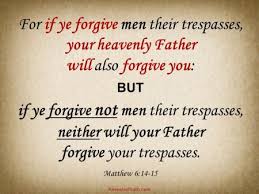
Jesus explains in Matthew 6:14-15: “For if you forgive others for their transgressions, your heavenly Father will also forgive you. But if you do not forgive others, then your Father will not forgive your transgressions.” Do you see the consequences of unforgiveness? Some Calvinists would claim that God has already forgiven us, thus Jesus’ words are not that critical. But the Lord plainly warns that if we forgive others, then God will forgive us, but if we refuse to forgive others, God will not forgive our sins. This shows the dreadful consequences of harboring unforgiveness in our heart!
We must always be ready to forgive our fellow-believers and everyone else. Jesus said, “Be on your guard! If your brother sins, rebuke him; and if he repents, forgive him. And if he sins against you seven times a day, and returns to you seven times, saying, ‘I repent,’ forgive him” (Luke 17:3-4). We are to speak to the sinful brother in private (Matthew 18:15), then with one or two others (v. 16), then the assembly of believers are to be notified. If he refuses to listen even to them, he is to be rejected (vv. 17-18). The point is that we as individuals and also as a body of believers must seek the repentance of the offender and be ready, willing, and eager to forgive the repentant sinner (1 Corinthians 1:1-13; cf. James 5:19-20). Let us not allow an unforgiving heart to keep us from openly forgiving others.[1]
[1] Our book, Forgive and Be Forgiven!, discusses this matter in some detail.


 You can reach us via e-mail
at the following address:
You can reach us via e-mail
at the following address: