
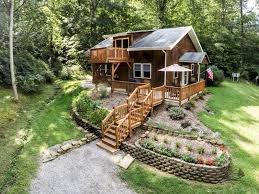
The Wilderness
Thinking Through Wilderness Living
Richard Hollerman
This may seem strange and even unconventional, but we ask the question: Have you ever wanted to escape to the wilderness? By “wilderness” we have in mind, “a wild, uncultivated, uninhabited region, as of forest or desert” or maybe “a part of a garden set apart for plants to grow unchecked.” This is not exactly what we have in mind, for we refer to an area that is not necessarily “uncultivated” or “uninhabited” and we don’t refer to a garden that is a place where plants can grow unchecked.
But we refer to a place that will allow us to grow unhindered and unfettered, free to seek God and do His will at all times and in every sphere of our being. Is there such a place and condition on earth, in this life, and with our present limitations? Rather, instead of the conventional place that we often think of when we hear of “wilderness,” we refer to an area in woods, a forest, or a land that may be explored and settled. In such an area, do you ever wish to find a refuge from the busyness of the city life? This is what I would have in mind. Let me explain.
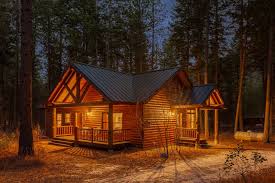
The psalmist says, “In the LORD I take refuge” but then he asks, “How can you say to my soul, ‘Flee as a bird to your mountain’” (11:1). Do we take refuge in God? And do you ever feel like a bird that wishes to flee to the mountain for refuge? If so, we need to find our delight, our refuge, our comfort in God and this comes through Christ Jesus. We may not be able to “flee” to a literal mountain, and this may not even be desirable. And we may not be able to flee as a bird in any way, but we may be able to find Him to be our refuge and comfort, our protection and shelter, in Him and in His love and mercy. Not long ago, we placed a couple of new articles on the website having to do with retreats and cottages—and this is actually what we mean.
Yet (in the midst of these difficulties) we must admit the innumerable blessings of country living and living in the wilderness. The two other articles we’ve placed on our website make mention of these and we encourage you to examine them.
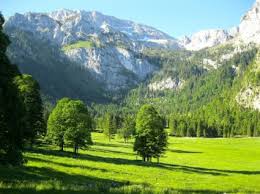
It may be the forests of northern California, western Oregon, or Washington State. It may be the mountains of Idaho, Montana, Wyoming, or Colorado. It may be the deserts of Arizona or New Mexico or Nevada. Or perhaps it could be the mixed land of Oklahoma, Texas, Nebraska, Kansas, or the Dakotas. Maybe it would be the woods of Minnesota, Wisconsin, or Michigan. Or possibly Idaho, Missouri, or Arkansas. Yes, it may be the hills and lower mountains of Tennessee, North Carolina, or Virginia. Or possibly the northern lands of New York, Vermont, New Hampshire, and Maine. Or it may be another area of America.
Or possibly the other areas of the world, such as Argentina, Bolivia, Africa, Australia, Europe, and the Islands of the ocean. We may find a sweet repose and calm retreat that beckons our attention and draws us to live. Wherever it may be, let us find a place to live out our brief years and fulfill the destiny that God gives to us.
We surely love the open spaces of this land and throughout the world. God has made all of this, by His power and grace. But we must realize that He has sent us to have contact with people—with all of the people of the world! This command is found in many places in Scripture. I am thinking of the so-called “Great Commission” found in the Bible such as Matthew 28:18-20; Mark 16:15-16; Luke 24:44-47; and Acts 1:8. This means that we need to reach out to people wherever they may be.
This “outreach” may be over the “backyard fence” or on the other side of the city or even the other side of the world. Since Christ may be coming at any time and since our death may occur at any time, and since people need Jesus at all times to rescue them from sin, death, and hell, we need to touch their lives with the saving good news of Jesus Christ (see Ephesians 2:2-10, 12-22).
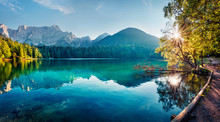
For this reason and other reasons, we may love the “open spaces” of the wilderness (the content of this article) but we love people more—much more. The wilderness (which is good, for God made it) is good, but people will last forever and ever! Is it possible to have both?
The wilderness is good for it allows one to think, and dream, and plan, and do things—without distraction. There is the sound of the breeze, the untamed winds, the rustling of the leaves, and the flowers at our feet. There may be the humming of the insects, the chirping of the birds, and the roaming of the animals on our property or in the forest. All of this may lead us to an awareness of God, the Creator, and of our responsibility to adore Him. But isn’t there more to life than these good and even praiseworthy things?
The “good” things in the wilderness, that may surround us, is not the only part of the story. All of this can also be a hindrance to the things of God if it keeps us away from preaching, teaching, having fellowship, and doing what we have been called to do (Mark 16:15-16; etc.). I suppose that it depends on our mindset and perspective.
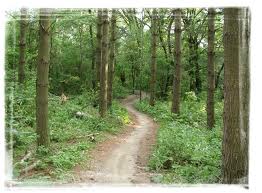
Sometimes we may want to “get away” from the rush and from the “hustle and bustle” of everyday life. We want to breathe free and it seems that the wilderness may offer this, without distraction. However, there are some drawbacks and roadblocks for us to consider. Consider these along with me:
- The cost of all of this (the property, the life, and the expenses) may be exorbitantly high, particularly if the location happens to be in a populated area.
- The weather may be quite cold or quite hot, depending on what we may choose. This surely can be a problem, for some of us have trouble half of the year, because of the cold, and also the other half of the year, because of the heat.
- There may not be brothers and sisters in Christ nearby, with whom to have sweet fellowship and to share life. In fact, we may be totally alone—which is not good (cf. Proverbs 18:1). (See our two articles above on the Website on this factor.)
- There may not be non-Christian neighbors to reach for the Lord or they may not at all be interested in God, in salvation, in Jesus, or in spiritual things.
- It may take much, much work, something that we have very little of in light of our reading, our study, our correspondence. “Homesteading” can take much effort and time!
- Perhaps this pertains to the first “problem” above—the cost. I have no idea where the hundreds of thousands (or could it be millions?) would come from.
- We might also mention also the heat or heater, the air conditioner, the insulation, the food preservation, the food growing, and so much more. All of this could pose a real problem that would need to be overcome—somehow.
- It would be good to mention that there would be the medical needs as well. We know that there seems to be some who go from birth to death, without any medical attention, but probably most (would it be 90% or 99%?) do need some sort of medicine, doctor visits, or even hospital visits. But how can any of this be done in the country (in the wilderness) and with a very limited income, far from neighbors, and away from city life.
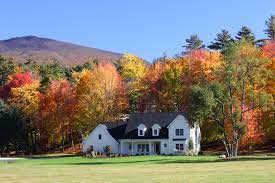
All of this weighs heavily on my mind and heart today. There must be blessings in this, with all of the factors and perhaps insuperable negatives, but I don’t know how to get around it. What do you think?


 You can reach us via e-mail
at the following address:
You can reach us via e-mail
at the following address: