
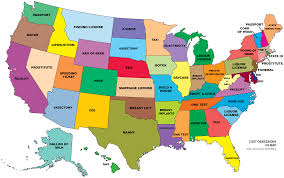
The Upside down World of America
Richard Hollerman
At one time the country of the United States was considered a wholesome place to live, work, and raise a family. It was a nation founded on “Christian” principles and sustained by a belief in God. This is not to say that every person professed Christianity but many did. From the time of the Pilgrims and Jamestown in the early 1600s, until 1776 when the nation was founded, there were a substantial number of people who claimed to be Christians.
Yes, there were some Jews (I think about 1%), some atheists, some skeptics (the third President—Thomas Jefferson—was one), but still there were many who professed Christianity. Especially after the “first great awakening” and the “second great awakening” in the eighteenth century, we do find many people who professed Christianity. No more. Personally, I am largely ashamed of the way this country is acting, believing, and professing—and it is hard to claim citizenship in it.
So much could be said about this that we really don’t know what approach to take. For example, just today we learned that the university system of Michigan (as we assume the remainder of the nation) is employing people to promote evil agendas. Several terms were used and we’ve heard of them being used again and again in various contexts. You have heard them too.
One of the terms is “diversity.” We all know that the term means that a certain group of people, diverse in belief and practice, do a certain thing. Today, many boast of “diversity” even though it has become a wicked term that means a group may stand for and promote “diverse” agendas—diverse lifestyles, diverse religions, and diverse views.
Diversity can be used in a good way—or, regretfully—a bad way. I can remember standing in line at a local supermarket that many of you have known (Kroger) and on the wall was a statement of what the store promoted. One was “diversity.” I thought that this was strange until I considered it and looked it up. It actually is used by immoral people to refer to different views and lifestyles—even though many of them may be evil.

Another prominent term is “inclusion.” This could be used in an acceptable way to indicate that certain people are “included” in this activity or that activity. But, once again, the term has been “hijacked” by sexually immoral people to mean that sodomites are “included” in this or that activity. In our contemporary world, it can mean that evil religions and faulty theological persuasions can be promoted.
Maybe another term would be “ecumenical.” Of course, in one respect this can be a neutral term but usually it is used in an evil way that offends God. We surely don’t want to be ecumenical in the sense that all Christian people are expected to blend with all religions and views. Wouldn’t this be an evil thing to do? Wouldn’t it sin against the Lord?
For example, we think that the average American assumes that some 30% of people are homosexuals. Wrong. According to Wikipedia, some 4.5% of adults are sodomites (https://en.wikipedia.org/wiki/LGBT_demographics_of_the_United_States). Of course, this doesn’t make this sexual orientation right for it is wrong and always will be wrong from God’s standpoint, but it does show that people in general simply are either unaware or unwilling to look at the facts. We know that this does seem high for we remember that one statistic referred to 1% of the American public practiced this sin. And we know that in many nations around the world, the number would be 0.1 or fewer, but in this immoral country of the United States we do have a great number of people to are involved in this evil.

Consider another statistic. We know that generally a person who has been married before is forbidden (by God) to remarry (Matthew 19:9). Probably this is a figure that is also faulty. Perhaps many think that half of all marriages would fail and then the husband or wife remarries. The figure is high but not that high. This is what we can learn:
Only 29% of previously married adults ages 18 to 24 (admittedly a small group) had remarried in 2013, compared with 67% of those ages 55 to 64. (https://www.pewresearch.org/social-trends/2014/11/14/chapter-2-the-demographics-of-remarriage/).
We believe that many countries would offer different statistics and many people would either practice desertion, or divorce, or remarriage, or no marriage at all..
Perhaps another question that we could ask pertains to smoking. And so we may ask, “How many Americans smoke?” Is the figure high (maybe 50%) or low (maybe 20%)? This is what we find: Actually, 30.8 million smokers are in the United States. This would be 12.5 percent of people use cigarettes. We know that some places in the world the number would be higher but in America the number has been going down. Yet, we all know that, from a Christian standpoint, this is a wicked practice that must be abandoned.

Let’s now ask the question, “How many people gamble?” Surprisingly, we discover that some 1.6 billion people in the world practice this reprehensible practice, which does seem like many inasmuch as the world population is about 7 billion! Some 26 percent of people gamble worldwide! (https://www.casino.org/features/gambling-statistics/#:~:text=World%20gambling%20statistics%20show%20that,at%20least%20once%20every%20year.). Many places ban gambling but Nevada is a hotbed of this vice where it is promoted.
Let’s look at one more statistic, although many more could be chosen. This time, let’s look at pornography. We know that from a Christian standpoint, this sin must be eradicated and shunned. But this is not the view of many in America. We find this:
Based on a survey of 3,288 people, we now have up-to-date, accurate statistics on many aspects of pornography use, attitudes about pornography, and demographically sorted differences based on age, gender, and faith.
Here’s a taste – and you can order the entire study HERE!
The Set Free Summit gave solutions to the public health crisis of pornography and sex trafficking.

Generational differences
- When asked to prioritize what people consider to be immoral, adults put “not recycling” pretty near the bottom of their list. Teens and young adults, however, consider “not recycling” to be more immoralthan viewing pornography!
- 22% of young adults aged 18 to 24 consider porn to be good for society, and 8% of that age group actually think it is “very good for society.” Nobody over age 50 thought so.
- The 18 to 24 year old group is more likely than any other age group actively to seek out porn (57% at least monthly). Meanwhile, over 70% of those over 50 say they “never” actively seek out porn.
Increase in porn use = decrease in sensitivity to porn
While there is no cause and effect relationship, it is clear that people who use porn are more likely to think it’s fine to do so—with the exception of Covenant Eyes users, pastors, evangelical Christians, and many people over 50.
- Data from The Porn Phenomenonshows that today the definition of pornography is much different than it was in the days of Ricky and Lucy sleeping in separate beds with their pajamas on. An image of sexual intercourse is NOT pornography to 21% of adults. A fully nude image that is sexually arousing is NOT pornography to 47% of adults. A fully nude image is NOT pornography to 76% of adults.
- Only about 50% of respondents under age 50 who use pornography think that sexual images are “always wrong” if they portray sexual acts that may be forced or painful.
- Only about 40% of respondents under age 50 who use pornography thought that sexual images are “always wrong” if the images are of someone being depicted in a demeaning way. Common examples of demeaning images are women wearing dog collars and leashes being led by their masters and even eating and drinking from dog dishes. Other images show women with foul and obscene labels written on their bodies, or in some cases tattooed on their bodies. And it really is much worse, but not fit for this writing. How can 40% of any civilized society think that’s OK?
(https://www.josh.org/what-are-the-most-up-to-date-stats-on-pornography/?mwm_id=49661098744 6&mot=J79GNF&gclid=CjwKCAjw9LSSBhBsEiwAKtf0nxbPKjK6rl8WkizCH9Jj9aJ0ZrwubcpDSZX8U-j1WnfdxL7-j8nKbhoC4zsQAvD_BwE)
Again, we must say that probably in the world, this is a very high number and in the country of America it is also high. We might think that it is too high and unrealistic but there may be portions that are accurate. We must also remember that certain locations may have lower numbers and other portions of the nation the numbers may be higher.
From these little snapshots of American life we learn that sin is “alive and well” and we think that large portions of the earth these figures would be very high. Yet we somehow think that America is a godly nation and that nearly everyone is a Christian!
Far from it. America is filled with sin and depravity. This country is wicked and getting more and more evil as the years go by. It may be that the number of professing “Christians” is higher than in many—actually “most”—other countries but it is still very sinful in many respects.

While some countries may be evil religiously, and America may not be, still it is evil in many other ways. For example, we learn that over 99% of people in Afghanistan are in a false religion and most people in Great Britain, France, Germany, and such nations are not really professing “Christians” (only about 3 percent or as high as 5% of people in Europe are church-going), still we find vast unbelief in some countries. We must remember that nearly all of the 3 percent we have quoted above are in a false religion and not a solid “Christian” one.
We are aware that an article like this may have deflated many of you. You maybe were under the mistaken impression that most people in America were true believers in Christ Jesus and we have come along to show that very few people either profess Christianity or practice Christian ideals. We find this very sad.
What can we do? We can’t change America. Neither can we change Europe. We can’t change those countries where atheism and false religion prevails (whether we speak of Russia, or China, or Japan, or India). But we can determine to be God’s people ourselves. Whatever other people do, we can choose to love, believe in, and serve the living God and promote the ways of Christ. Let us do so for God’s own glory!


 You can reach us via e-mail
at the following address:
You can reach us via e-mail
at the following address: