
Self-righteousness
We know that righteousness is utterly important for us, as God’s children. We can’t be saved without it! The Greek dikaiosune means “the character or quality of being right or just.”[1] Dikaiosune refers to “whatever is right or just in itself, whatever conforms to the revealed will of God. . . whatever has been appointed by God to be acknowledged and obeyed by man. . . . the sum total of the requirements of God. . . . religious duties.”[2]
Jesus said, “Unless your righteousness surpasses that of the scribes and Pharisees, you will not enter the kingdom of heaven” (Matthew 5:20). He also said, “Seek first His kingdom and His righteousness” (6:33a). The Lord said that the “righteous” will receive eternal life (25:46). Jesus said that it is the “righteous” who will “shine forth as the sun in the kingdom of their Father” (Matthew 13:43). We must seek righteousness and it must surpass the Pharisee’s form of this righteous condition.
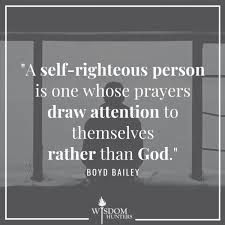
“Self-righteousness” is more of an attitude than a condition of existence. It has to do with the way we look at ourselves and God’s standard. Self-righteous has been defined as “piously sure of one’s own righteousness; moralistic.”[3] It may also be defined as “confident of one’s own righteousness, especially when smugly moralistic and intolerant of the opinions and behavior of others.”[4] This may be an example of how a secular definition can lead us astray. The Christian should have some confidence in his own righteousness since only the righteous will be eternally saved. Further, this definition disparages “moralism,” whereas the Christian is to strive for perfection in his morality.
Further, the Christian is also to be “intolerant” of the opinions and behavior of others if they are offensive to the will and ways of God! For this reason, we use self-righteousness to mean that one has a too elevated view of his righteousness and tends to look at external standards rather than internal purity.

Furthermore, self-righteousness would refer to the idea that one can achieve his own righteousness through personal effort and achievement, apart from God’s work in us. It would also be a reference to a prideful spirit that looks down on others. You will remember that Jesus told a parable to “some people who trusted in themselves that they were righteous, and viewed others with contempt” (Luke 18:9). Paul said that the Jewish people did not know about “God’s righteousness and [were] seeking to establish their own,” thus “they did not subject themselves to the righteousness of God” (Romans 10:3).
Although unbelievers are lost, some of them think that they are righteous. But Paul says, “There is none righteous, not even one” (Romans 3:10). No one can perfectly obey God, thus we all need to be forgiven of sin and unrighteousness, and thus receive the righteousness of God. We need to have God’s righteousness credited to our account or imputed to us, based on Christ’s redemptive, righteous act on the cross (cf. Romans 3:24-28; 4:3-8; 5:1-2; Philippians 3:9-10; Titus 3:5-8).
Having been “justified” or declared righteous through the grace of God, based on the death of Christ, we are to go on a live a righteous life or personally become righteous through the power of the Holy Spirit (Romans 8:6-14). The obedient believer is one who received “the abundance of grace” and “the gift of righteousness,” and “will reign in life through the One, Jesus Christ” (Romans 5:17; cf. vv. 15-21).
We must personally live a righteous life if we are truly born of God and belong to Him. John says, “Everyone also who practices righteousness is born of Him” (1 John 2:29). He goes on to say, “Little children, make sure no one deceives you; the one who practices righteousness is righteous, just as He is righteous. . . . By this the children of God and the children of the devil are obvious; anyone who does not practice righteousness is not of God, nor the one who does not love his brother” (2:7, 10).
This shows that a follower of Jesus will live a righteous life, while the unbeliever will live in unrighteousness. The point that we want to establish is that we must not be self-righteous in this. While we must be personally righteous, we must refuse to have a self-righteous attitude. All of our righteousness comes through the power of the Holy Spirit in us who enables us to live a holy and righteous life—actively producing righteousness or doing right.
[1] W. E. Vine, Expository Dictionary.
[2] Ibid.
[3] The American Heritage College Dictionary.
[4] Random House Webster’s College Dictionary.


 You can reach us via e-mail
at the following address:
You can reach us via e-mail
at the following address: