
Overcoming Sin through Christ
A Comprehensive List of Sins
(Alphabetically Arranged)
Richard Hollerman
The plan of this study is simple. We will look at a large number of sins, one by one, alphabetically. We will define the sin, describe it, and comment on it, along with noticing Scripture references on the particular entry. Some illustrations will be offered along with the description.
Pride, Arrogance, Conceit
Pride may be defined as “pleasure or satisfaction taken as an achievement, possession, or association. . . . Arrogant or disdainful conduct or treatment; haughtiness.”[1][1] It is “a high or inordinate opinion of one’s own dignity, importance, merit, or superiority; conceit; arrogance.”[2][2] Sometimes pride can be used in a less than evil way, indicating “a sense of legitimate ‘pride’ in a person or ‘glorying’ in God.”[3][3] We would suggest that it is best not to even use the term “pride” in order to avoid any wrongful connotation.
The Greek hyperephania can be used of “arrogance.” Jesus says that “pride” or “arrogance” comes from “within, out of the heart of men,” and serves to “defile the man” (vv. 21-23). The term hyperephanos also occurs. Mary exalts the Lord, saying that “He has scattered those who were proud in the thoughts of their heart” (Luke 1:51). Paul says that in the last days “difficult times will come,” and that people will be lovers of self and “arrogant,” people whom we should “avoid” (2 Timothy 3:2, 5).
God hates pride so much that we read, “God is opposed to the proud, but gives grace to the humble “(James 4:6; 1 Peter 5:5). In contrast to a prideful attitude, Peter says, “Clothe yourselves with humility toward one another. . . . Humble yourselves under the mighty hand of God, that He may exalt you at the proper time” (1 Peter 5:5, 6; cf. James 4:10). Paul said that one is “not to think more highly of himself than he ought to think” (Romans 12:3).
This is a serious sin, for Paul says that those who are “arrogant” or prideful are “worthy of death” (Romans 1:30, 32). Because we stand by faith, Paul is able to write, “Do not be conceited, but fear” (Romans 11:20). He also says that those who are “rich in this present world” are likely to be “conceited” (1 Timothy 6:17). Physioo is another word indicating pride.
Paul urges that “no one of you will become arrogant in behalf of one against another” (1 Corinthians 4:6; cf. vv. 18-19). He then writes, “For who regards you as superior? What do you have that you did not receive? And if you did receive it, why do you boast as if you had not received it” (v. 7). When we regard ourselves as “superior” over another and claim that we are better than others, either in appearance or abilities or intelligence, we forget that God is the Giver of our intelligence and physical capabilities.. We have no reason to boast or be proud!
Schlink discusses at some length the nature of pride and its sinfulness:
This hidden pride is the most dangerous sin. For instance, we cannot stand it, when people pay little attention to us and do not honor us, but pay honor to someone else. We cannot stand it, when we are not worth anything to others, because we do not have many talents or shining qualities or a charming personality. We cannot stand it, if someone reproaches us and humiliates us in the eyes of others. We cannot stand it, if we do not have a position of leadership and cannot set the pace. We do not realize that all of this stems from our pride.[4][4]
On the contrary, we often feel sorry for ourselves, because people do not give us what our talents, education and capabilities deserve, or because we have to do work that is “beneath us.” We feel sorry for ourselves, because we have not received the education or training necessary to carry out our job. Or we cannot bear the fact that our parents are uneducated, that we ourselves have not reached a prominent position. All these things oppress us and make us unhappy. We blame the external conditions, and we deceive ourselves about our real motives.[5][5]
We cannot digest any criticism. . . . Our desire to have others think that we are especially humble and modest can also be hidden pride. We are too concerned about what others think of us. Pride can appear in many different forms. . . . Let us choose freely a lowly position that will humble us. Whenever possible, we should not accept any titles or honors; we should not try to stand out in any group, or strive for positions of honor. . . . Only true humiliations can really make us humble and free us from pride. Whoever becomes a “friend” of humiliations will find that they have great power. When they are accepted in love for Jesus, they are like a hammer that smashes our pride to pieces.[6][6]
Paul the apostle says that love is incompatible with a prideful or arrogant spirit. He says, “Love does not brag and is not arrogant” (1 Corinthians 13:4). Whenever you are tempted to brag of your accomplishments and have a “puffed up” or arrogant spirit, remember that love is far different than that. Love will lower self and exalt others rather than exalt self and lower others. The apostle says that “arrogance” is a sin for which we must repent (2 Corinthians 12:20-21).

Pride is related quite closely with conceit and vanity. Conceit may be defined as “a favorable and especially unduly high opinion of one’s own abilities or worth.”[7][7] It is “an excessively favorable opinion of one’s own ability, importance, wit, etc.; vanity.”[8][8] Vanity is similar. It means “excessive pride in oneself or one’s appearance; character or quality of being vain.”[9][9] Schlink claims that “the highest goal of a conceited person is to be complimented.”[10][10] She continues with these questions:
How do others react to us? Are we good-looking? Are we popular? Then our conceit grows and grows, but in the end it will make us unhappy. For the greater it becomes, the more it begins to tyrannize us. We can no longer do anything without reflecting on how others will react.[11][11]

Probably all of us have been too concerned about the estimation or evaluation others have of us. We become hyper-concerned about the opinion of others and the reputation that we have before others. We don’t naturally go through life, but always are very concerned with the way we look, the clothes we wear, the shoes we wear, the impression we give, the vacations we take, the education that we display, and so much more.
When others praise us, our vanity is increased. When we receive an award or public recognition, we become more and more conceited. Musicians, preachers, educators, leaders of all kinds, sports stars and athletes, and Hollywood actors and actresses must have a huge problem with conceit. But it can affect all of us!
Schlink continues with insightful words about the meaning and results of conceit:
Vanity places the ego on the throne. It idolizes the ego and that is why it is a great sin. Every idol takes over the place that God ought to have in our life. That is why the same verdict that God pronounced over the idol-worshippers will hit us. For we cannot serve god and our ego-idol. We want others to burn incense to our ego. Our conceitedness wants others to admire our looks, our intelligence, our talents and our abilities and burn incense to worldly riches. Then we spend great sums of money for an expensive wardrobe and other things that might help us gain the admiration of others. But above all, conceit, the desire to be pleasing to our fellow-men, makes us insensitive to the most important thing for our life here and in eternity: that we be pleasing to God.[12][12]
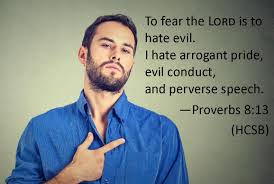
The Hebrew Scriptures (the Old Testament) likewise condemn a prideful spirit. The Lord “hates” “haughty” or prideful eyes (Proverbs 6:17). We also read this strong statement about God’s hatred of pride: “The fear of the LORD is to hate evil; pride and arrogance and the evil way and the perverted mouth, I hate” (8:13). Pride will bring disgrace: “When pride comes, then comes dishonor, but with the humble is wisdom” (11:2; cf. 18:2). “A man’s pride will bring him low, but a humble spirit will obtain honor” (29:23).

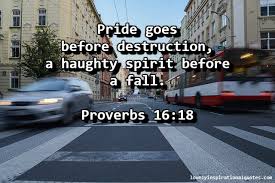
Notice a further verse that shows God’s abhorrence of pride: “Everyone who is proud in heart is an abomination to the LORD; assuredly, he will not be unpunished” (16:5). Solomon says that “haughty eyes and a proud heart” are considered sinful (21:4). One final one from Proverbs: “Pride goes before destruction, and a haughty spirit before stumbling” (16:18). Because pride is so heinous to God, we can see why He would humble the prideful Nebuchadnezzar (Daniel 5:30-32) and kill the prideful Herod (Acts 12:20-23).
Richards sums it up well: “Pride as a self-exalting attitude is wrong. But God wants us to take a healthy pride, and to find joy, in what he is doing in our lives. As arrogance, pride is a source of sin, for only the humility that keeps us responsive to the Lord and his Word is appropriate in our relationship with the one who is truly the living God.”[13][13] As we noted before, it may be wise to not even use the term “pride” since it can be so easily misunderstood. Surely there would be other acceptable terms to use in its place.
[1][1] The American Heritage College Dictionary.
[2][2] Random House Webster’s College Dictionary.
[3][3] Mounce, Expository Dictionary.
[4][4] You Will Never be the Same, p. 131.
[5][5] Ibid., pp. 131-132.
[6][6] Ibid., pp. 133-134.
[7][7] The American Heritage College Dictionary.
[8][8] Random House Webster’s College Dictionary.
[9][9] Random House Webster’s College Dictionary.
[10][10] You Will Never be the Same, p. 51.
[11][11] Ibid.
[12][12] Ibid., pp. 51-52.
[13][13] Expository Dictionary.


 You can reach us via e-mail
at the following address:
You can reach us via e-mail
at the following address: