

Our Dear Mennonite Friends
Richard Hollerman
We assume that most of our readers know that the denomination called “Mennonite” comes from Menno Simons of the Netherlands. This Dutch Catholic priest became upset by the unbiblical tradition of the Catholic church and began to speak against it.
The movement that we know as Mennonitism is a collection of various groups that have their origin in Germany, Switzerland, the Netherlands, and other nations nearby in the early 1500s at the time of the Protestant Reformation. On another front, Martin Luther at this time turned away from the fellowship of his early childhood (the Roman Catholic Church) after he became a priest. His and Melanchthon’s legacy was the Lutheran Church (named after him).
John Calvin was trained to be a lawyer in his native France but moved to Geneva, Switzerland, and set up a theocracy there, with some success. People from Scotland escaped persecution in their native land and moved to Switzerland for a time, after which they returned to Scotland and established the Presbyterian Church at this location. All of this was known as Calvinism. Both the Lutherans and the Calvinists opposed the “Radical Reformers” known as the Mennonites.

Today, Mennonites (the descendents of the so-called “Radical Reformers”) are found in various countries of the world. Some of the more prominent ones would be (according to Wikipedia):
Mexico: 34,014
Canada: 149,422
Bolivia: 26,699
Paraguay: 36,009
Germany: 47,492
India: 257,029
Kenya: 35,575
However, we also find the following information that fills in our understanding of this sect:
United States (500,481)
Ethiopia (310,912)
India (257,029)
Dem. Republic of the Congo (225,581)
Canada (149,422)
Indonesia (101,761)
Tanzania (66,350)
Thailand (63,718)
Zimbabwe (50,287)
Germany (47,492)
Paraguay (36,009)
Kenya (35,572)
Mexico (34,014)
Angola (30,555)
Bolivia (26,699)
One of the hallmarks of this denomination (or groups of denominations) is that of persecution. From the very first, the Lutherans, the Catholics, and the Calvinists persecuted the Anabaptists in many ways—through burning, through drowning, through imprisonment, and others. (There are some 4,000 accounts of these burnings.)We might also keep in mind that one of the main tenets of this group was “non-resistant” thus they would not fight back against their persecutors.
We find this description under “Mennonites” that may broaden our understanding of these series of groups:
Congregations worldwide embody the full scope of Mennonite practice, from Old Order Mennonites (who practice a lifestyle without certain elements of modern technology) to Conservative Mennonites (who hold to traditional theological distinctives, wear plain dress and use modern conveniences) to mainline Mennonites (those who are indistinguishable in dress and appearance from the general population).
Mennonites can be found in communities in 87 countries on six continents. Seven ordinances have been taught in many traditional Mennonite churches, which include “baptism, communion, footwashing, marriage, anointing with oil, the holy kiss, and the prayer covering.”
The largest populations of Mennonites are found in Canada, the Democratic Republic of the Congo, Ethiopia, India, and the United States. There are Mennonite colonies in Argentina, Belize, Bolivia, Brazil, Mexico, Uruguay, Paraguay, and Colombia. Today, fewer than 500 Mennonites remain in Ukraine. The relatively small Mennonite Church in the Netherlands still continues where Simons was born. (https://en.wikipedia.org/wiki/Mennonites)
When we look at the 30,000 or so different sects and denominations within Protestantism of the world, we must admit that Mennonitism is unique in nature. Earlier we discussed these series of churches and the source stated that they are known for several different positions and doctrines. Let’s look at these before we proceed further.
- The Mennonite view of baptism in the sixteenth and seventeenth centuries that led to the death of thousands basically revolved around the fact that they rejected “infant” or “baby” baptism and insisted on adult baptism. Of course, we must affirm that this was a positive element in itself. Biblical baptism is a baptism of believers—not of little infants.
However, we must make an objection—a serious one. The Mennonites (or Anabaptists—meaning rebaptizers) inherited pouring from their Catholic forbears. We do wonder how Menno Simons and other men of Mennonite leadership could have derived this from Scripture. Biblical students among our readers know that the Greek term baptizo or baptisma means “the process of immersion, submersion and emergence” (W. E. Vine, Vine’s Complete Expository Dictionary). Why didn’t this denomination come to baptism as immersion and insisted on retaining pouring? We wonder.
Further, we wonder why modern Mennonites of all kinds generally see “baptism” as a means of entering the church (which they wrongly assume means the Mennonite Church). Why didn’t they see baptism as one element in coming to Christ for salvation in itself? (Please see other articles on this website.) We wonder.
- Another element in the Mennonite belief system would be communion. Sadly, this denomination only “communes” (or has the “Lord’s supper”) every 6 weeks or 6 months or even one year. Is this correct?
Biblical students and historians know that the early Christians, from the time of Christ onward, met each Lord’s day (the first day of the week) to remember the Lord in the “breaking of bread” (see Acts 2:42; 20:7; 1 Corinthians 10:16-17; 11:17-33). Thus, instead of irregularly, the early believers did this as a regular feature of their gatherings. In fact, it was the leading portion of these gatherings.
- This is another regular feature of Mennonite meetings. Generally, this practice would be done only once a year. By this, we mean that the men in one portion of the meeting place meet and wash each other’s feet; the women who meet in another part of the meeting place do the same.
This is done according to the example of the Lord with His disciples at John 13:3-17 (see also 1 Timothy 5:10). As you may remember, Jesus said, “If I then, the Lord and the Teacher, washed your feet, you also ought to wash one another’s feet. For I gave you an example that you also should do as I did to you” (John 13:14-15). This practice is also followed by Primitive Baptists, Church of the Brethren, Brethren Church, Brethren in Christ Church, Plymouth Brethren, and others.
We have some misgivings about all of this. The bottom line is that if this were meant to be an actual practice, why was it mentioned only once? Further, why would most of these modern denominations only practice foot-washing infrequently (generally once every 4 weeks, 24 weeks, or a year)? If this is to be done along with the breaking of bread, it is fairly clear that the early Christians did the latter every first day of the week. If so, why wouldn’t the footwashing occur at the same time? These are questions that should be answered.
- We do know that the early Christians held marriage very highly. They believed in one marriage (of a man and woman), rejected separation and divorce, and promoted the idea that this married couple were to remain together for life. This remains true today, at least among the more conservative branches of Mennonitism.
Among the more liberal portion of the Mennonite Church, sadly we must say that many do not hold to this view of marriage and opposition to divorce. We find a similar view among the more liberal Protestants among which they live.
Here we might also say that conservative Mennonites also have a view of their children that is somewhat different from the general public. They have more children. They believe in teaching and training their children according to the ways of God. Among the very conservative branches, they have “church schools” (that are sometimes called “parochial” schools by others) that teach their children in a more godly fashion.
- Anointing with oil. We find in Scripture that the sick were “anointed” with oil according to James 5:14-16; see also Matthew 10:8; Luke 10:8-9; Mark 6:13. This is something that Mennonites and other “Plain people” (which is a common name used for this theology and practice).
Although anointing is something that can be practiced, we would question whether this is something that should be imposed since it is only found once in the New Testament. But since it is mentioned, we think that the Mennonite practice is permissible—but perhaps not to be dogmatized.
- The holy kiss. Some of our readers may fully support and know what this is whereas some Mennonites and surely Protestants in general either do not know the term or reject it as an “ordinance” or “sacrament. When two Mennonite men or two Mennonite women greet each other, they give each other this “greeting” as a way of acknowledging the other, showing approval of the other, or otherwise expressing a positive greeting.
Based on such passages as Romans 16:16; 1 Corinthians 16:20; 2 Corinthians 13:12; 1 Thessalonians 5:26 and 1 Peter 5:14, we can see that it has plenty of Biblical support by way of instruction and example. As to whether these Biblical passages should be accepted as God’s will for us today or an acknowledgement of a first-century practice is the question here.
- The woman’s prayer covering. This is a practice that some insist must be seen today. Based on 1 Corinthians 11:3-16, this would say that a Christian woman must wear some sort of covering or veiling on her head. The practice varies. Some would say that this must be part of a woman’s regular attire at virtually all times (perhaps not during sleep or showering), while others would say that the woman must wear a veil only while she “prays or prophesys.”
The practice varies here. Some would say that this refers only to public prayer rather than private prayer. And some would say that the “prophesying” refers to a supernatural manifestation of knowing and speaking truth while others would say that this refers to any “teaching” activity (such as in singing or speaking to other women or teaching a child). Although there are many questions regarding the precise usage of the women’s veiling, generally conservative Mennonites (as well as conservative Brethren and others), we might say that in some form this may be a good and helpful symbol. (Liberal Mennonites have entirely discarded this practice.)
Although the discussion above would refer to the traditional “seven ordinances” of conservative Mennonites, we might want to add this: Most Mennonites (at least of a conservative nature) would believe in the doctrine of “non-resistance” that some may call “pacifism.” (See our article on the history of the Military, recently published in this website.)As part of the centuries old practice of non-resistance, conservative Mennonites would not defend themselves from political, governmental, or even personal “enemies.” Rather, they would acquiesce to the enemy in whatever way this is appropriate under the circumstances.

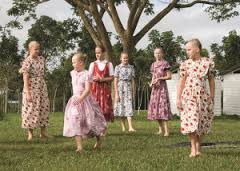
Perhaps another distinctive would be the conservative Mennonite practice for women to wear a special kind of dress called a “cape” dress. Although this may be considered somewhat unusual, we see this garb as entirely warranted and good in light of the rank immodesty that we find people (including women) indulging in today. The “cape” dress is a woman’s dress that has two parts to it, especially in the upper portion, that entirely covers a woman’s anatomy. Probably it is a piece of clothing that was common even among non-Mennonites in the past.
Perhaps we should mention something about “church organization” here. The little that we know, from our studies, the Mennonite Church believes and practices a “Three Office” pattern, consisting of a “pastor” (or preacher or “minister”), the “deacon,” and a “bishop” or overseer. Generally, Protestants find in the Bible what is known as a “Two Office” pattern. Our belief is that the New Testament has these two positions (the servant [deacon] and the “pastor” (also known in Scripture as the shepherd). (Bible students tell us that the three terms are used interchangeably in Scripture—bishops [episcopos], shepherd [poimein], and elder [presbuteros]). Of course, when the entire New Testament scriptures are considered, there were many other positions and works—such as teacher, preacher [or evangelists], and others.M .
In contrast, many (but not all) Mennonite Churches do believe in the office of “Bishop” which would be a separate position in the church. This person may not only be over a local congregation but two, three, or more “churches.” Thus, we know of one church or denomination with a Bishop who resides in another state and makes periodic trips to this state to supervise one or more congregations. We find this to be totally unbiblical. But such is the way of Mennonitism.
We must remember that not all Mennonites are conservative. Some are liberal–very liberal–in their thinking and living. In fact, they are like other Protestants. Most of my interactions come from what I’ve read from many sources. Also, my contacts with Mennonites have been with more conservative ones. There are many different groups that take this label and even use the same nomenclature. Hopefully, our comments will be of help to you. RH


 You can reach us via e-mail
at the following address:
You can reach us via e-mail
at the following address: