
Must We Obey God?
This is a question that probably has been asked millions of times. “Must we obey God in order to have eternal life?” It is an important—even vital—question that must be asked and answered. How would you answer such a inquiry?
Suppose a professing “Christian” claims to be saved from sin but refuses to obey a clear command of the New Testament. Suppose that a person says he or she has been saved by Christ and His shed blood revealed in Scripture. But suppose that this person seems unconcerned about something that Paul, Peter, John, or the Lord Jesus Himself has said. Is such a person saved by “faith” or does disobedience nullify this claim to saving faith?
There are many ways to deal with this issue, aren’t there! Let’s look at some of the most common ones. This must be answered in the traditional 5-Point Calvinistic way and also a more modern but common and popular way. First, there would be the Confessional Calvinistic way of answering.
Some have tended to put it this way: It is true that one must believe and obey God to be saved. We are saved by faith “alone” but, as Luther said, we are saved by faith alone but not by faith that is alone. (We know that Luther was not a “Calvinist”—but he did hold to some Calvinistic views.) Thus, this Calvinistic way would say that one is saved by faith but we must definitely obey God in order to be saved. If someone doesn’t live a life of obedience or refuses to obey God, this would demonstrate that he was not really saved when he thought he was. Or it shows that a person wasn’t saved when we thought he was saved. Why? Because, according to this view, one who is saved will definitely obey God. But, if one doesn’t obey the Lord, this shows that he really wasn’t saved when he or we thought he was.
We believe that this view is utterly false, irrational, and (above all) it is unbiblical. There are too many warnings in Scripture that genuinely-saved people can live a careless life and fall into disobedience. Further, sadly, many or most of those who claim to be saved in this Calvinistic way really haven’t submitted to Biblical conversion of true faith, genuine repentance, full confession, or conscious and authentic baptism. (Let’s remember that most—but not all—Calvinists are also baby-baptizers which would rule out genuine conversion since an infant cannot truly repent and trust in God through Christ!) However, if possibly one has been truly saved, this theology of “election” (God’s choosing) will probably lead one to fail to live in absolute obedience to God’s demands.
The second variety may also be called “unconditional eternal security”—for one would say that such a person believed that the given individual thought he was saved at a certain time or perhaps actually was saved. This position is that when one is saved by “faith alone” he will definitely be saved right then and there. But such a person may or may not be interested in carefully obeying God! If he doesn’t obey the Lord, he is still saved, but he simply doesn’t act like it. Since one is saved by faith alone—and not at all by obedience—we must conclude that lack of obedience doesn’t negate that person’s salvation. He is just a “disobedient” believer! He is “saved” but disobedient—so goes this popular theology!
The third view that we will look at—that we have more respect for (and there are many varieties of views)—says that one is saved by faith but not by faith that is disobedient or rebellious. This view would say that the first Calvinistic one above is wrong for a person may actually think that he was saved but he has been disobedient. He reveals that he dwells in a “lost” condition though he claims to be saved.
But this 5-point Calvinistic view would also reject the second view described above. Remember that, according to that second view, obedience is not at all a requisite for salvation. If the person has been disobedient either before or after he thought he was saved, we conclude that the person may not have been saved at all. But surely now, he is lost since he doesn’t continue in faith and obedience. Or we might say, the person doesn’t maintain an obedient faith—or hasn’t obeyed the Lord since the time that he thinks he was saved. Yet he maintains that he has been “born again” and saved by trusting in the blood of Christ to save him. This view sadly is an empty boast for this form of “faith only” fails to really take the issue of obedience seriously.
Many passages have a bearing on these two views.
- The view that a saved person will be saved by faith alone and be obedient (if one doesn’t remain in obedience, this shows that he really was not saved at the beginning.
- The view that “eternal security” comes by faith alone and may or may not result in an obedient life. (We’ve known many who claim salvation are openly living a disobedient life.)
Let me cite a few verses even though we don’t have the time to deal with them at length. Please notice John 15:2, 6; 1 John 2:1-6; 2 Peter 2:20-22; Revelation 2:10-11; Matthew 7:13-21. In order to deal with these three views, we need to look at several more passages. Let’s do this.
We find an interesting verse at the end of the Old Testament book that we call “Ecclesiastes.” Notice verse 12:13: “The conclusion, when all has been heard, is: fear God and keep His commandments, because this applies to every person.” Notice particularly the requirements, “Fear God” and “Keep His commandments.” We don’t read what will be the condition if one fails to “fear God” or refuses to “keep His [God’s] commandments,” but we can see that this is a very important requirement.
Now, let’s go to the New Testament. In Matthew 7:21, we read: “Not everyone who says to Me, “Lord, Lord,’ will enter the kingdom of heaven, but he who does the will of My Father who is in heaven will enter.” These words of Jesus our Lord shows that thinking or saying something means nothing; rather, we must “do the will” of God if we wish to enter the kingdom of God. Faith is important—even essential, and not optional—but this faith must do God’s will and be obedient if we wish to enter God’s kingdom.
In the Gospel of John (the gospel of faith) we read these words of our Lord: “Truly, truly, I say to you, if anyone keeps My word he will never see death.” This puts it somewhat differently. This shows that one must “keep” the word of Christ to “never see death” (or to live forever with God). Does this show that obedience is important to you? If we wish to “never see death” (or have eternal life) we must “keep” Christ’s words!
Most of us would recognize that we must love Jesus if we hope to do God’s will and please Him. Thus we read what Jesus said: “If you love Me, you will keep My commandments.” Do we love Jesus? Then we will obey Him. We continue reading: “He who has My commandments and keeps them is the one who loves Me; and he who loves Me will be loved by My father, and I will love him and will disclose Myself to him” (John 14:14, 21).
Do we love Jesus? If we do, we will be loved by God. (If we don’t love Jesus, this suggests that we cannot claim God’s love!) Further, we see that we are to “keep” the commandments of Jesus for such a person is the one who loves Him. Further, if we love Jesus, we will be loved by the Father. Also, Jesus will love us and disclose Himself to us. All of this shows the importance of loving Jesus and obeying Him! We should be fearful of either dismissing love or obedience!
Let’s notice two more verses in this same chapter of John 14: “If anyone loves Me, he will keep My word; and My Father will love him, and We will come to him and make Our abode with him” (v. 23). Let’s continue: “He who does not love Me does not keep My words; and the word which you hear is not Mine, but the Father’s who sent Me” (v. 24). Again, this shows how vital it is to love Jesus and “keep” His word. If we do this, God will love us and both Jesus the Son and God the Father will make their “home” with us. Conversely, if we do not love Jesus, we will not keep His words! Isn’t this simple! Those who say that they merely love Jesus and trust Him for eternal salvation—but refuse to obey the words of Christ—are failing to understand Scripture. They are plainly violating Scripture. Let us love and obey for, as the song puts it, “There is no other way”!
As we read 1 John, we come to these words: “By this we know that we have come to know Him, if we keep His commandments. The one who says, ‘I have come to know Him,’ and does not keep His commandments, is a liar, and the truth is not in him” (1 John 2:3-4). Notice the next verse: “Whoever keeps His word, in him the love of God has truly been perfected. By this we know that we are in Him: the one who says he abides in Him ought himself to walk in the same manner as He walked” (vv. 5-6). But what if a person refuses to keep the words of Jesus and walk as He walked? Doesn’t this show a lack of love and will this not show a disobedient attitude? This is a clear passage that must not be overlooked!
Let’s pass by many other passages and come to 1 John 2:17b where we read: “. . . the one who does the will of God lives forever.” Who lives forever? The one who merely “believes” in Jesus? As important as this is, the apostle says that “the one who does the will of God lives forever.” The one who “believes” the will of God? No, the one who “does” the will of God (obeys His Word) is the one who will live eternally! Does this mean you? Does it mean me?
If we remain in this significant book but focus on prayer, we read this: “Whatever we ask we receive from Him, because we keep His commandments and do the things that are pleasing in His sight” (1 John 3:22). According to this verse, we must “keep” the commandments of God and do the things that are pleasing to Him! Doesn’t this show how vital it is to keep God’s commandments—obey Him and His words?
In the same chapter (3:24a), we read: “The one who keeps His commandments abides in Him, and He in him.” Doesn’t this say that we must “keep” God’s commands and, if we do, we will “abide” in God and He will abide in us! This shows how important it is to obey God and keep His commands! Obviously, this is speaking about the commands of God and Christ in the New Testament and it doesn’t address the matter of keeping the many commands of God in the Old Testament—the Law of Moses.
If we continue to read in this all-important book of the Bible, we see this: “By this we know that we love the children of God, when we love God and observe His commandments. For this is the love of God, that we keep His commandments; and His commandments are not burdensome” (1 John 5:2-3). This shows the direct relationship between love and obedience in the New Testament and lack of love and disobedience. What about the one who claims to love God but refuses to obey Him?
Let’s now examine another passage: “This is love, that we walk according to His commandments. This is the commandment, just as you have heard from the beginning, that you should walk in it” (2 John 6). Similar to others in this section, here we see that in order to show love, we must walk according to God’s commandments. Do we do this?
We could go on to the many other passages with the same idea (cf. Romans 2:10; Galatians 5:19-23; 6:9; Ephesians 2:10; Matthew 28:20). But what we have seen thus far shows that we must obey God out of a sincere desire to love and trust Him. We definitely must “keep the commandments” of Jesus and of God the Father, to show our love and also to manifest a submissive attitude toward God. A hundred other passages would say the same or something similar!
But why is it that so many millions of people don’t see the need to obey the Lord? One of the primary reasons is that they have been told and read so often that we are saved by faith alone. And this “faith” has not just been mentioned; it has been told and written emphatically! Preachers and authors have emphasized that we are saved “by faith, plus nothing.” They have been told that we must not add anything at all to faith or this will dilute or nullify faith. They have said that if obedience to God is mentioned or emphasized, this will detract from the fact that we are saved by faith.
As a matter of fact, it is true that we are saved by faith. As Paul has said, “By grace you have been saved through faith; and that not of yourselves, it is the gift of God; not as a result of works, so that no one may boast” (Ephesians 2:8-9). Thus, we must do nothing that would detract from the fact that we are saved, forgiven, and reconciled to God through faith.
But notice that Paul says, “A man is justified by faith apart from works of the Law” (Romans 3:28). Most of us know that Luther inserted the word “alone” after “faith” in his German translation: “A man is justified by faith alone apart from works of the Law.” Notice also that we are not declared righteous by “works of the Law.” Which law? The Law of Moses (cf. Luke 2:22, 23, 27, 39). Therefore, it is important that we emphasize that we are saved by faith—but not by faith alone, without love or obedience. While there is no merit or worth in anything we do (including faith and obedience), still it is important that we faithfully obey our God.
But what kind of faith? A working faith or an obedient faith! While we are not saved on the basis of our obedience, per se, we are saved by a faith that works through love (cf. Galatians 5:6; James 2:14-26). Both faith and obedience are necessary. Thus, we read, “He who believes in the Son has eternal life; but he who does not obey the Son will not see life, but the wrath of God abides on him” (John 3:36). We receive eternal life by faith. And we must also remember that if we do not “obey” Jesus, the Son of God, we will not experience eternal life; rather, God’s wrath will abide on us. Let us believe, yes, but let us have an obedient faith! Let us have faith, but let this faith obey God and be fully submissive to the Lord Jesus.
We offer this short study to you with the hope that we will be more discerning about both faith and obedience. Let’s make sure that we love God, but let this love be expressed in obedience—a loving, trusting obedience that fully obeys God and obeys His Word. Remember that if we don’t obey God or refuse to obey the Lord out of love, we show a lack of love and lack of faith. We are to lovingly obey. And we are to believingly obey.

Our obedience to God must be extensive. For example, the Lord said, “Man shall not live on bread alone, but on every word that proceeds out of the mouth of God” (Matthew 4:4). Question: Do we live on God’s words? Jesus said, “Enter through the narrow gate; for the gate is wide and the way is broad that leads to destruction, and many are those who enter though it. For the gate is small and the way is narrow that leads to life, and there are few who find it” (Matthew 6:13). Question: Do we enter that narrow gate and walk that narrow way? Jesus said, “Do not store up for yourselves treasures on earth. . . . but store up for yourselves treasures in heaven” (Matthew 6:18-21).
Question: Where is our treasure? Jesus declared, “Everyone who confesses Me before men, I will also confess him before My Father who is in heaven. But whoever denies Me before men, I will also deny him before My father who is in heaven” (Matthew 10:32-33). Question: Do we confess or deny Jesus publicly? Jesus said, “Whoever divorces his wife, except for immorality, and marries another woman commits adultery” (Matthew 19:9). Question: Have we divorced a spouse and married someone else? This is just a sample of the many, many instances of how a person may disobey the Lord instead of submitting to the commands of God. What about you?
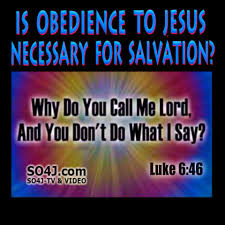
The day will come when we stand before Christ Jesus, our perfect Judge (2 Corinthians 5:10). Let us live a life of faithful obedience now so that we will not be ashamed before Him at His coming (1 John 2:28). Further, let us not fall into the false teaching that we can be saved even if we refuse to obey Him. Let us live a life of careful obedience and not presume upon the grace of God by carefully living in obedience now and not in rebellion, insubmission, or disobedience (Romans 6:1-2). We definitely are saved by grace through faith but this assurance is for those who conscientiously submit to Christ’s Lordship in sincere obedience. What about you?


 You can reach us via e-mail
at the following address:
You can reach us via e-mail
at the following address: