

How Often Should I Read My Bible?
Richard Hollerman
We probably all know that God doesn’t give any “hard and fast” stipulations about this in His Word. We also know that in the Old Testament time, when Hebrew (and also Aramaic) was used, there could be no personal copies of the Scriptures (with their 39 books) available. It took months if not years to copy the entire Old Testament and few could ever afford the animal skins (vellum or parchment) needed for such a monumental task.
In the New Testament era things were a bit different. Copies of the manuscripts were being made but they were also expensive and nearly unobtainable. We do know that some were available and used (cf. 2 Timothy 4:13) but the common person surely couldn’t obtain the complete New Testament (new covenant) writings, with 27 books, for they all had not been written at the time of Peter and Paul (for example) and were not completely written until the end of the first century.
We are led to ask this pointed question because of the relevance of Bible reading for our spiritual life: “How often do you read the Bible?”
If you do accept the Bible as God’s Word, how often do you read it? If it is without error, if it did come as God’s “gift” to us, if it is authoritative to us and meant for us to live and be judged by it, how do we view it and how often to we peruse its precious pages? We realize that there are many false views on this and we must deal with them. Some believe God’s Word is only accurate in the KJV (or AV) and anything else is false (this would be called the King James Only fallacy. Others accept all sorts of paraphrases that mutilate God’s Word in various ways. But others may accept good, standard translations and say that this is God’s Word (such as the NASB, the ESV, and others).
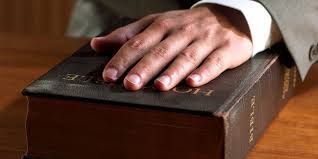
But if we do accept the Bible as God’s Word to us, do we not only believe it, obey it, but also read and even memorize portions? Do we merely think of God Word as good and worthy, but do we do nothing more? Do we take the Bible to “church” (and this is another question that needs to be addressed) then bring it back home and let it on the shelf to collect dust for the next week?
If the Muslims memorize their false Qur’an (Koran), which is almost as long as the New Testament, and are taught to revere it, do we do this with God’s written Word (the Bible)? If the average person reads the newspaper, reads magazines, watches TV, listens to the radio, listens and talks via the I-Phone, and (of course) commutes for a half hour or even an hour, one day, every day, what about what people do with the Bible? If this is God’s “love letter” to us and if the Bible instructs us to know and do His will, do we really read it with these thoughts in mind?
Consider this statement from the words of Jesus Himself: “Man shall not live on bread alone, but on every word that proceeds out of the mouth of God” (Matthew 4:4). These words, taken from Deuteronomy 8:3, show how important it is to read or take in God’s very words! We “live” by these words—spiritually live! And this is why we must be daily Bible readers!

Let’s also remember Paul’s words: “We write nothing else to you than what you read and understand, and I hope you will understand until the end” (2 Corinthians 1:13). Do we take this to heart? Do we read and understand now and always?
We also read in Psalm 1:2, regarding the person who seeks God and His word: “His delight is in the law of the LORD, and in His law he medicates day and night.” Although we may not follow the “law” of God, for it has been taken out of the way, do we “delight” in the word of God? Is this Word something that we delight in “day and night”—at all time? Or is it something that we only consult from time to time?
Or what about Psalm 119? This is an “alphabetic acrostic in which each stanza of eight verses is devoted to successive letters of the Hebrew alphabet, each verse of a particular stanza beginning with the same letter” (Ryrie). The writer of Psalm 119 says, “Open my eyes, that I may behold wonderful things from Your law” (v. 18). Is this something that we do regularly, dutifully, and religiously? The writer goes on to say that he “keeps” God’s Word (v. 67) and seeks to “learn” this Word (v. 71). This word has been his “delight” and he “loves” this! In fact, “It is my meditation all the day” (v. 97). He uses ten different terms for God’s Word and all of the 176 verses (except three of them) contain some reference to the Word of the Lord!

As we come back to the New Testament, we hear the words of Christ when He refers to some who “hear the word of God and do it” (Luke 8:21). He went on to say, “Blessed are those who hear the word of God and observe it” (11:28). When Scripture refers to “hearing” the Word of God, this surely must be a reference to our reading and doing God’s Word (since the “hearing” part is not something that we do as frequently today). (See Mark 4:18, 20; Luke 12:12-13). We are to read God’s Word just as these dear people “heard” God’s Word.
But do you read the word of God regularly? Is this something that you regularly, prayerfully, studiously, earnestly, and submissively do? Is the Word of God something that you “consume” regularly? Is it a daily activity for you? There may be some who read God’s Word six, seven, or eight hours a day, but these people might be admonished to give even more attention to not just believing in the Word but obeying it! Is this something that we share with others, teach others, and encourage others to obey?

But for most of us, we probably don’t read God’s Word more than one, two, three, or four chapters each day! At different times it has been different amounts. Sometimes I have read and studied verse by verse, carefully taking in the Word from the various languages (the Word was written in Hebrew, Aramaic, and the New Testament, in Greek), and at other times I have read at a more manageable and regular speed.
So the question again arises: How often do you read the Scriptures? We find that the answers may be found here. This would be the response from one source:
Currently, only 10 percent of Americans report daily Bible reading. Before the pandemic, that number was at about 14 percent. Whether we come to 10 percent or 14 percent, we find this to be an important number. If 10 to 14 percent of people read their Bible every day, we find this to be commendable!

We further find that the number of people who regularly read the Bible to be according to these findings:
Just over one-third of U.S. adults (34%) reads the Bible once a week or more, while half (50%) read the Bible less than twice a year (including “never”). In between these two extremes, we find those who read the Bible more than twice a year, but not on a weekly basis (16%). Overall, one in six U.S. adults (16%) reads the Bible most days during the week, up from 12 percent in 2020. (https://www.barna.com/research/sotb-2021/).
With this in mind, we must say that millions of people do read the Bible regularly (34%), but not as frequently as we would like.
The following statistics do show that many people do accept the Bible as God’s inerrant Word while some do take a hostile attitude:
Interestingly, most descriptions of what the Bible actually is still fall within the realm of Christian orthodoxy. One-quarter of respondents (26%) believes the Bible is the actual word of God and should be taken literally. Three in 10 (29%) hold the view that the Bible is the word of God and, though it does not have errors, parts of it can be interpreted both literally and symbolically. Sixteen percent say the Bible has some historical or factual errors but is still the word of God. Taken together, seven in 10 Americans claim a view that regards scripture as the word of God (71%). Over half of American adults (55%) hold what is known to be a “high” view of scripture, which deems the Bible without error.

A much smaller proportion of Americans holds lower views of the Bible. One in eight (13%) indicates the Bible is just another book that contains stories and advice. One in 10 (9%) holds the view that the Bible is not inspired by God, but rather reveals the writers’ understanding of the principles of God. Some Americans (10%) take a Bible Hostile stance, believing the Bible was written to control or manipulate people.
(https://www.barna.com/research/sotb-2021/)
We know that in certain portions of the world, these facts would be somewhat different. For instance, in Europe, the number would be far different, with many rejecting the Bible as God’s Word. Further, as we might imagine, in other portions of the world (such as Northern Africa, the Middle East, the Far East, and the like), the numbers of those who accept God’s Word as coming from God Himself, would be far fewer! But in other places, such as Africa, we find that many are more regular in their Bible reading.

It is important for us to remind ourselves that simply reading God’s Word regularly does not indicate that we are submissive to that Word! No, we may simply read it for comfort, for a legalistic reason, or out of habit. God wants us to find God’s Word to be the “food” for our soul and our very life! Further, we don’t read God’s Word (the Bible) because it is expected of us, or because it is something urged on us by parents or a Christian leader, but because of His Word itself. We want to relate to God himself, thus we want to know what He says, what He expects of us, and how we are to express our faith and love toward Him. This is the only thing that will do!


 You can reach us via e-mail
at the following address:
You can reach us via e-mail
at the following address: