
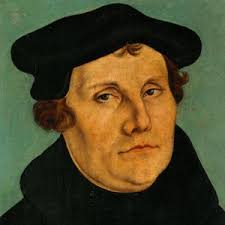
Lutheranism?
Richard Hollerman
As many of you know, I grew up in the Lutheran Church. Until I was 15 years of age, I was part of this denomination and regularly participated in all that it offered. When I was this age, I departed from this communion but continued to be interested in it after this and since this time. In fact, I have visited various Lutheran congregations over the years and could list the various Lutheran bodies I examined. (Perhaps 8 or 10 or even 12 churches.)

There are some 77 million members of this communion worldwide. (This seems like a huge number but it is what the source has said.) (https://www.google.com/search?q=Lutheran+bodies+worldwide). By way of comparison, there are about 85 million Anglicans, 12 million Methodists, 75 million Presbyterians (according to Wikipedia). We also find these statistics:
Germany 10,814,631
Ethiopia (10,404,128)
Tanzania (7,916,263)
Sweden 5,900,000)
Indonesia (5,705,589)
India (4,386,957)
Denmark (4,339,411)
Madagascar (4,000,000)
Norway (3,746,308)
If we go to another course, we discover that there could be as many as 81 million Lutherans worldwide. (https://en.wikipedia.org/wiki/Lutheranism_by_region).

There are a lot of aspects to this that would be worthy of noting but we hardly know where to begin. Germany, Sweden, Denmark, and Norway would be northern European nations that traditionally had “state” churches—or churches and denominations supported by the state. Of course, we think that many of our readers would know how unbiblical this would be. Ethiopia, Tanzania, and Madagascar would be connected with Africa and would have their origin during the Colonial period (and this also would be unbiblical). Indonesia and India would also come from the Colonial period, thus this too would be unbiblical.
We may wonder about America. If there are 77 or 81 million members worldwide, what about this one nation? We find this information: “United States accounts for one-eighth of the world’s Lutheran population, but only around 4 million of them are members in the Lutheran World Federation. Some Lutherans would not be part of a “Federation” or “Convention.” But they do remain part of an evil denomination that would tolerate this.
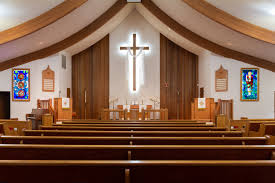
As to the history of this denomination, we learn the following:
Lutherans are one branch of Protestant Christianity and have been in America for almost 400 years. Historically they have immigrated to America from Lutheran countries in Europe, especially Germany and Scandinavia. Immigrants during the eighteenth century founded Lutheran congregations in the middle colonies, while westward expansion and further immigration from Europe centered Lutherans in the American Midwest. Lutherans formed regional and national denominations based on geography, ethnicity, and theological differences, In the twentieth century they continued to grow, and mergers reduced the numbers of denominations by 1988 to two major denominations: the Evangelical Lutheran Church in America and the Lutheran Church-Missouri Synod. In 2015 there were close to seven million Lutherans in America. (https://oxfordre.com/americanhistory/view/10.1093/acrefore/9780199329175.001.0001/acrefore-9780199329175-e-381).
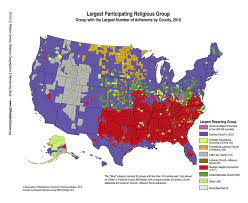
The denomination of Lutherans that I was part of as a child has become the “Evangelical Lutheran Church” but this has become liberal in nature, tolerating and endorsing all sorts of wickedness. This Lutheran denomination may endorse and approve of the evils of sodomy, feminism, transgenderism, and other forms of evil.
On the other hand, the “Missouri Synod” Lutherans have remained more conservative (if we may call it this). They have rejected sodomy and other evils. Let’s focus on the United States itself.
As for America at large, we learn this:
Several important mergers of various American Lutheran churches took place in the 20th century. The first two occurred in 1917, when three Norwegian synods formed the Norwegian Lutheran Church of America (NLCA), and in 1918, when three German-language synods formed the United Lutheran Church in America (ULCA). In 1930 the Joint Synod of Ohio, the Evangelical Lutheran Synod of Iowa, and the Buffalo Synod formed the American Lutheran Church (German). In 1960 the American Lutheran Church (German) merged with the United Evangelical Lutheran Church (Danish) and the Evangelical Lutheran Church (Norwegian) to form the American Lutheran Church (ALC). The Lutheran Free Church (Norwegian), which had initially dropped out of merger negotiations, joined the ALC in 1963. Two years after the formation of the ALC, in a parallel development, the ULCA joined with the Augustana Evangelical Lutheran Church (Swedish), the Finnish Evangelical Lutheran Church, and the American Evangelical Lutheran Church (Danish) to establish the Lutheran Church in America (LCA). The Missouri and Wisconsin synods chose not to engage in merger negotiations because of the more liberal stance of the other Lutheran bodies.
In 1988 the ALC and the LCA—the former prominent in the Midwest, the latter on the east coast—together with the smaller Association of Evangelical Lutheran Churches, merged to form the Evangelical Lutheran Church in America (ELCA). This made the ELCA, with about 3.4 million members, the largest Lutheran church body in North America. The nearly two-million-member Lutheran Church–Missouri Synod remained the second largest Lutheran church. The third major church of North American Lutheranism was the Wisconsin Evangelical Lutheran Synod, with more than 400,000 baptized members. The ELCA’s constituency is chiefly found in the Northeast and the upper Midwest; other concentrations of Lutherans are found in states where Lutherans first settled: Pennsylvania, New York, Virginia, and the Carolinas. Canadian Lutheranism, about 350,000 strong, is divided into two bodies paralleling the ELCA and the Missouri Synod in the United States. The larger of the two, the Evangelical Lutheran Church in Canada (ELCIC), had about 180,000 members in some 600 congregations by the early 21st century. In 1997 the ELCIC adopted an “evangelical declaration” as “a guide for its future mission.” Canadian Lutheranism is strongest in Ontario and the Western provinces.
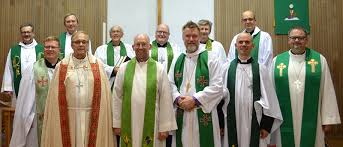
From this we discover that there are multiple Lutheran bodies in America alone (not to speak of the millions overseas). Many are liberal but such groups as the Lutheran Church, Missouri Synod (they don’t all live in Missouri), and the Lutheran Church, Wisconsin Synod (again, these Lutherans don’t all live in Wisconsin), are to be found in America. Some of these Lutheran groups are liberal—very liberal—and must be rejected as “Christian” in any respect.
Additionally, many of these Lutheran bodies come from various European countries (such as Germany, Denmark, Sweden, or Norway) and some of them are converts to these denominations. We are not aware of whether they are liberal or not—but we would suppose that those in Europe may be while those in the Far East and Africa may not be. As to why the latter would even consider Lutheranism when this denomination is involved in perversions we do wonder.
This is a “transgnder” bishop in California and Nevada who is a sodomite in the Evangelical Lutheran Church (obviously, he or she is not an “evangelical” or in any way Biblical).

Doctrinal Practices
What about their doctrines? We have seen something of the background, the history, and the location of Lutheranism in the world and especially in the United States, but we must ask something about the beliefs and practices of this denomination.
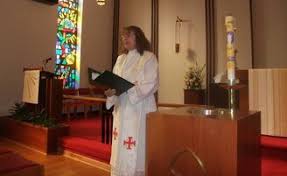
The photo below shows a wicked Lutheran congregation;

Much could be said about this but it would take a long, long article. There are various points that we might want to present for your thinking:
- 1 Some of the Lutheran denominations are somewhat more conservative than others. This we would find more positive.
- 2 Some Lutherans worldwide would be very negative, with liberal ideas and practices. Many of the members do not even attend church meetings.
- 3 Most Lutherans belong to a “state” controlled denomination—the members are devoted to a national organization.
- 4 Of course, the denomination was begun by Martin Luther, a disaffected Catholic priest, trained and educated by Catholics but then he departed from this background.
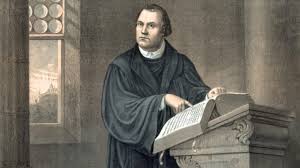
- 5 His followers began to name themselves after Luther himself, hence we find people calling themselves “Lutherans” today. I used to “pride” myself with this label but when I was 15, of course, I learned differently.
- 6 Lutherans do use a human name (Lutheran Church), which obviously is unbiblical (cf. 1 Corinthians 1:10-13).
- 7 The Lutheran Church, for the most part, tenaciously holds to the false doctrine of infant “baptism” whereas the Bible teaches faith and repentance as embodied in baptism (many scriptures, e.g., Matthew 28:18-20; Mark 16:15-16; Acts 2:36-41; 8:12; 22:16; etc.)
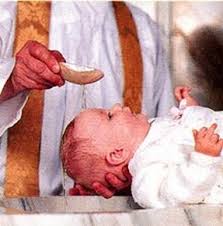
- 8 Lutherans pour water on babies rather than baptize them (the Greek word is baptize which means immerse, plunge, submerge, etc).
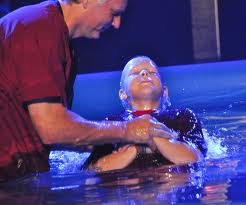
- 9 Instead of local autonomy, the church is a full-blown denomination with earthly headquarters (depending on the branch).
- 10 There is a president or bishop over each of the churches, whereas the Bible pictures multiple “bishops” or “elders” in each
- 11 There is a ritualistic pastor system with pastors over the congregation, whereas the Bible knows nothing about Lutheran pastors or ministers.
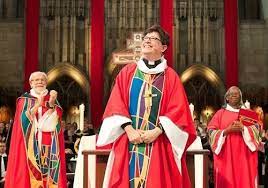
- 12 Lutheranism is a fully-developed denomination with a clergy system.
- 13 Some (but not all) Lutherans are involved in evils of various kinds, such as sexual immorality.
- 14 Lutherans like “confessions,” hence we learn of “confessional Lutherans” that hold to the Lutheran confessions of Martin Luther and Philip Melanchthon, such as the “Small Catechism,” the “Large Catechism,” and others (2 Thessalonians 3:15-17).
- 15 Many Lutherans do not at all use or take their Bibles to “church” or “Sunday school.” (See Psalm 1.)

- 16 The Lord’s supper, or “communion,” or the “breaking of bread” (the term preferred in the first couple of centuries) may be taken every month or more seldom than this (Acts 2:42; 20:7; 1 Cor. 11).
- 17 The Lutheran Church has “choirs” of various kinds (Ephesians 5:19; Colossians 3:16).
- 18 The hymns or songs may be worldly, instrumental, and the like—rather than the simplicity of common music that is non-instrumental (as in the early assembly).
- 19 Rather than teaching and preaching local autonomy, Lutheran Churches generally have inter-congregational relationships.
- 20 Priestcraft is seen in their unbiblical use of “Reverend” and the like (Psalm 111:9; KJV).
- 21 Lutherans generally are deeply involved in militarism and politics—rather than remaining neutral as Christ did (John 18:36; Matthew 5:38-42).

- 22 Lutherans seldom or even never practice “withdrawal of fellowship” (that some may call “discipline”) rather than practice such passages as 1 Corinthians 5:1-13; 2 Thessalonians 3:6ff; and many others.
- 23 Worldliness is rampant in many or most congregations (1 John 2:15-17; James 1:27; etc.)
- 24 Such organizations as Luther League, Boy Scouts, Girl Scouts, etc are to be found.
- 25 Seminaries, theological schools, parochial schools, and similar institutions are used.
- 26 Home schooling is used but surely not at all—100 % of the time.
- 27 Women may not be under male authority (cf. 1 Corinthians 11:3, 4-16; 14:33-37; 1 Timothy 2:11-15; etc.
- 28 Immodesty may not be part of the women’s (and men’s) clothing styles (cf. 1 Timothy 2:9-10; 1 Peter 3:3-4; etc.)
Of course, there would be many, many additional points here but this would be sufficient to show the fact that Lutheranism is (regretfully) not at all the assembly of the New Testament. We encourage you—if you are a Lutheran—to escape while you can and seek to be simply a follower of Christ without denominational affiliation.
Sources
Martin Luther, The World Book, Volume 12, pages 527-529
(www.google.com/search?q=Lutheran+bodies+worldwide).
wikipedia.org/wiki/Lutheranism_by_region
https://truediscipleship.com/wp-admin/post.php?post=22630&action=edit


 You can reach us via e-mail
at the following address:
You can reach us via e-mail
at the following address: