

The Sadness of Suicide and the Vanity of Life
(The life and death of “Father Knows Best” Robert Young)
Recently I have noticed the attempted suicide of a personality that we probably all have read about, regardless of our age or station in life. I knew of this before but at this time this incident has brought the trauma once again to me along with spiritual lessons to be learned.
If you were to transport yourself back many years to an earlier time, you will either remember or perhaps at least have heard of Robert Young. Who was he? He was the well known actor in the television program entitled “Father Knows Best.” This is the program that was unique at the time and even since. We read this regarding its format:
As before, the character of Margaret was portrayed as a “voice of reason,” but Jim’s character was softened to that of a thoughtful father who offered sage advice whenever one (or more) of his children had a problem. Jim was a salesman and manager of the General Insurance Company in Springfield, while Margaret was a housewife. Their home was located at 607 Maple Avenue. One history of the series characterized the Andersons as “truly an idealized family, the sort that viewers could relate to and emulate.” (https://en.wikipedia.org/wiki/Father_Knows_Best)
Possibly those of you who were born since the beginning of the new century (of 2000) will not be able to identify with any of this, but we must say that parts of the weekly offerings were of a better sort than problems today. Personally, I haven’t seen TV since about 1963, thus I don’t know much about contemporary programs other than what I’ve read. And what I have read shows a very vulgar and evil offering of programs today. Yet perhaps some of you have viewed reruns of some of these programs of the past (distant past, for some of you). People may not understand how the father (“Father Knows Best”) could be the “head” of the house, the mother could be so wise and truly be a housekeeper, and how a family could have three children—but this is how it was. Quite amazing!

Sadly, the records show that in 1966, Young suffered a “nervous breakdown” (if there is such a condition). During this time, he recovered at his ranch outside of Los Angeles. He found this strange since he had portrayed a “calm and together” person but “in his private life demons were plaguing him constantly” (https://findadeath.com/robert-young/).
As the years progressed, Young suffered from Alzheimer’s and heart problems (Ibid.). A couple decades later, this is when Robert sought to persuade his wife to commit suicide with him (for she also drank heavily). His wife died in 1994. At the time of his death, he was a resident at Westlake Village and during part of this time, he required 24 hour surveillance, especially because of his Alzheimer’s disease. When he reached age 90, very few showed up for his birthday celebration. Finally, at 9:10 PM, on July 21, 1998, Young died of respiratory failure. He was 91 years of age.
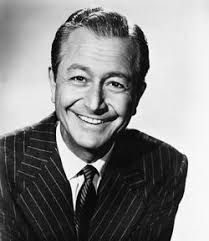
But let’s return to his series on “Father Knows Best.” After the show’s demise, Young went on to another series, “Marcus Welby, M.D.” For those of you who are not aware of this television drama, this is what we discover:
Marcus Welby, M.D. is an American medical drama television program that aired Tuesdays at 10:00–11:00 pm (EST) on ABC from September 23, 1969, to July 29, 1976. It starred Robert Young as the title character, a family practitioner with a kind bedside manner, who was on a first-name basis with many of his patients (and who also made house calls), James Brolin, as Steve Kiley, M.D, a younger doctor who was Welby’s partner, and Elena Verdugo, who played Welby and Kiley’s dedicated and loving nurse and office manager, Consuelo Lopez. Marcus Welby, M.D., was produced by David Victor and David J. O’Connell. The pilot, “A Matter of Humanities”, had aired as an ABC Movie of the Week on March 26, 1969. (https://en.wikipedia.org/wiki/Marcus_Welby,_M.D.
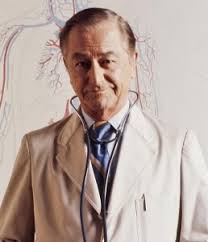
The point is that Young (who played “Marcus Welby, M.D.”) was a doctor with “a kind bedside manner, who was on a first-name basis with many of his patients.” He also made “house calls” when needed. How many of our own doctors may be described in this manner? How many are “kind” and have a “first-name” friendship with us? How many come to our house when needed? I do remember that my doctor (many years ago) did come to the house for a call, but surely this was extremely rare—possibly never done in our day.
This series went from 1969 to 1976 (seven years) until it ceased to be seen. Again, the theme of this program was somewhat unusual as we compare it with programs that are aired today, in our own age of crudeness, impersonalization, and materialism. Gone are such days—if even such days truly existed. As we know, something may be found in our minds but it may not be based on fact.
Unlike so many other Hollywood players, Young had only one wife with whom he spent his entire life. We read:
He was married to the same woman for more than 60 years. Mr. Young was 17, and in high school, when he met Elizabeth Louise Henderson, who was 14. They married in 1933. She died in 1994. Mr. Young is survived by their four daughters, Betty Lou Gleason, Carol Proffitt, Barbara Beebe and Kathy Young. He also had six grandchildren and two great-grandchildren.” (https://www.nytimes.com/1998/07/23/arts/robert-young-of-father-knows-best-dies-at-91.html)

The Sad Ending of Robert Young
We might think that someone like this actor would “have it made” and that he would be happy and fulfilled with his life. He was in perhaps hundreds of different movies and TV dramas. He had a life-long marriage until the end—which is somewhat rare for Hollywood. He had four children from one wife—again, somewhat unusual for a Hollywood personality. He was wealthy since he had been exposed to the public in so many different programs and movies. But what can we know about Robert Young?
Young’s career with “Father Knows Best” filled a desire of the American public. Many wanted a more wholesome venue that would show an idealized family without many problems. Although this was somewhat unrealistic, the producers did want to fill a “need” that the public wanted and provided it through Young. We read this summary:
After a prolific career as a dependable film actor during Hollywood’s golden age in the 1930’s and 40’s, he went on to even greater success in the two long-running television shows that were among the most popular of their respective decades. Mr. Young’s television roles were built on integrity, clarity and kindness. Although ”Father Knows Best,” which Mr. Young originated on NBC radio in 1949, was a classically wholesome and idealized portrait of family life in the Midwest, circa the 1950’s and early 60’s, Mr. Young insisted that the character he played, Jim Anderson, should be more realistic than other sitcom dads, who were often dimwitted. (https://www.nytimes.com/1998/07/23/arts/robert-young-of-father-knows-best-dies-at-91.html
We can be grateful that Young wanted a program that emphasized “integrity, clarity and kindness” and that it was “a classically wholesome and idealized portrait of family life in the Midwest,” but was this all there was?
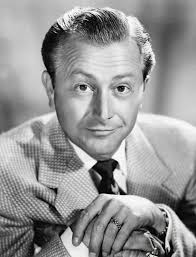
This part as “Father Knows Best” was not the end for Young. Remember his subsequent TV programs. We read further concerning “Marcus Welby, M.D.”:
”There was a very sympathetic quality to Young as an actor,” Mr. Tinker said. ”You can easily confuse him with a kindly doctor. He was also a guy who had a backbone. He was very determined.”
The one-hour show, with James Brolin as his youthful medical sidekick, had its premiere on Sept. 23, 1969, and was an instant success. It became the biggest hit in the history of the ABC network up to that time. Part of its initial success was a result of weak competition, with CBS and NBC opposing it with news documentary programs. But viewers clearly adored the show and remained faithful to it against stronger competition in later years. The show’s last broadcast was in 1976.
Although the series itself, unlike ”Father Knows Best,” dealt with serious problems like autism, blindness, LSD side effects, drug addiction and leukemia, Marcus Welby himself was something of a fantasy doctor who took a deeply personal approach to all of his patients. He treated not only physical ailments but the fears and family issues of each person.
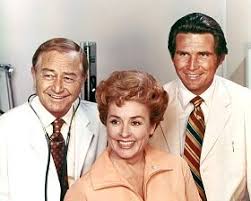
”He’s understanding and dedicated,” Mr. Young once said of Marcus Welby. ”These are words that for some reason have fallen into disuse. I knew from the start that I had to come back and play this man.”
Mr. Young, who won two Emmys for ”Father Knows Best,” won a third for ”Welby.” He was also held in esteem by medical groups. (https://www.nytimes.com/1998/07/23/arts/robert-young-of-father-knows-best-dies-at-91.html)
Young indicated that he sought to stand for at least some degree of morality. For instance, he seemed to oppose sodomy/homosexuality and abortion. We read this:
The show was not afraid to tackle social issues. The 1973 episode “The Other Martin Loring“, was about a middle-aged man whom Welby advised to resist his homosexual impulses. The Gay Activists Alliance (GAA) zapped ABC, occupied its New York headquarters and picketed.[1] The next year, “The Outrage” was a story of a teenaged student who was sexually assaulted by his male teacher, showing homosexuality with pedophilia. Seven sponsors refused to buy television advertising time, and 17 television network affiliates refused to air the episode.[2][3] This was the first known instance of network affiliates refusing a network episode in response to protests.[4]
In addition, an episode dealing with abortion was refused by San Diego area ABC affiliate XETV, a station licensed to Tijuana across the border in Mexico, due to that country’s views on the practice at the time.[5] (https://en.wikipedia.org/wiki/Marcus_Welby,_M.D.)
We doubt that a program today that would oppose such sins would be approved by such a large majority of the public. Whether Young had an opposition to these sins or whether this just reflected a society standard, we don’t know.
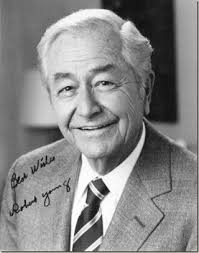
What was Young like behind the scenes? Do we assume that this “wholesome” father really was like this? Not at all. We read that “he was privately battling personal demons, including alcoholism. He attended Alcoholics Anonymous meetings during the making of the show” (https://www.nytimes.com/1998/07/23/arts/robert-young-of-father-knows-best-dies-at-91.html). Despite his trademark portrayal of happy, well-adjusted characters, Young’s bitterness toward Hollywood casting practices never diminished, and he suffered from depression and alcoholism. . . . “ (https://en.wikipedia.org/wiki/Robert_Young_(actor)#Personal_life_and_death.
Perhaps the major negative in Young’s life was his attempt to take his own life. Let’s notice this. One report has it:
He had a history of alcoholism and depression. In 1991, at 83, he tried to commit suicide by running a hose from his car’s exhaust pipe to the interior of the vehicle. The attempt failed because the battery was dead and the car wouldn’t start. He later admitted that he had been drinking when he asked his wife to enter into a suicide pact with him and then tried to take his life. (https://www.nytimes.com/1998/07/23/arts/robert-young-of-father-knows-best-dies-at-91.html)
Young’s attempt to commit suicide at age 82 failed—thankfully. And his wife did not take her life either. But this account revealed Young’s desperation and negative way of dealing with his problem (his sin).
For thirty some years, Young was a drunkard (or alcoholic). Toward the end of his life, he was able to renounce this sin and live a sober life.
According to one report, “Young died of respiratory failure at his Westlake Village, California home on July 21, 1998, and is interred at Forest Lawn Memorial Park, Glendale.” (https://en.wikipedia.org/wiki/Robert_Young_(actor)#Personal_life_and_death).
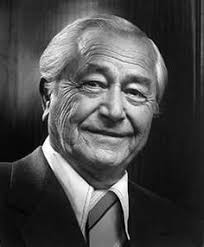
As I read this account of Young’s life, several points came to my mind.
First, we don’t always know what is happening inside of a person, inside his heart. We may think that a person is well, as many people probably assumed of Young, but the person is sad, grieving, and depressed. Obviously, we don’t know all of his motivations, for they may have been very selfish or self-centered, but we just don’t know. We read this:
Lt. Bob Barrier, of the Los Angeles County Sheriff’s Department, said Young, 83, ran a hose from the exhaust pipe to his car’s interior last Saturday about 7:45 a.m. Authorities were alerted after Young called a tow truck to try to start his car. The driver noticed the hose, Barrier said, and contacted authorities. “Mr. Young had been drinking and he admitted that he had tried to end his life,” Barrier said.
The actor voluntarily admitted himself for a 24-hour observation at Thousand Oak’s Charter Hospital, a psychiatric treatment facility, Barrier said. Barrier did not know how long Young remained at the hospital. Young’s agent could not be reached for comment Saturday. After the incident, Young’s wife of more than 40 years, Elizabeth, 81, told authorities that her husband had asked her to “form a pact with him” to commit suicide. “She thought he was just rambling,” Barrier said. (https://www.latimes.com/archives/la-xpm-1991-01-20-me-841-story.html#:~:text=Actor%20Robert%20Young%2C%20who%20for,last%20week%2C%20authorities%20said%20Saturday.)
Young has had a history of depression and alcoholism, and in previous interviews with The Times spoke of feeling guilty about portraying the steadfast, contented Jim Anderson of “Father Knows Best” when he was often unhappy.
This tells me that we need to be kind and patient with people for we just don’t know what they are going through. It is true that God says that most people who don’t know Him through Christ are not truly righteous or centered in Him, but still they are worthy of respect and patience.
Second, even when a person remains in a marriage for many decades, and we think that he and his wife are well, actually they may be in great distress. In this case, the report says that he agreed with his wife to take his/their life. God must have had other plans. His car battery was dead and when he called for someone to give a jump, using booster cables, the worker or mechanic reported that Young was trying to commit suicide. This led to his hospitalization and eventual release. Apparently his wife outlived him by a few years. But living in a marriage does not guarantee that the person is well and the marriage is without problems. As Solomon said so well: “The heart knows its own bitterness, and a stranger does not share its job” (Proverbs 14:10).
Third, this is a very important point. Regardless of whether a person achieves earthly fame (as did Robert Young), and regardless of whether millions find in a person encouragement and inspiration (as did many in their relationship to Young and the parts that he played), this is not the essence of living. Many people seemed to adore Young, particularly because of the character he played in “Father Knows Best” and the personality that he played in “Marcus Welby, M.D., but this cannot give true happiness. We assume that Young found some satisfaction in playing the parts of these two dramas, however this was not enough to give him a sense of achievement and true blessing in life.
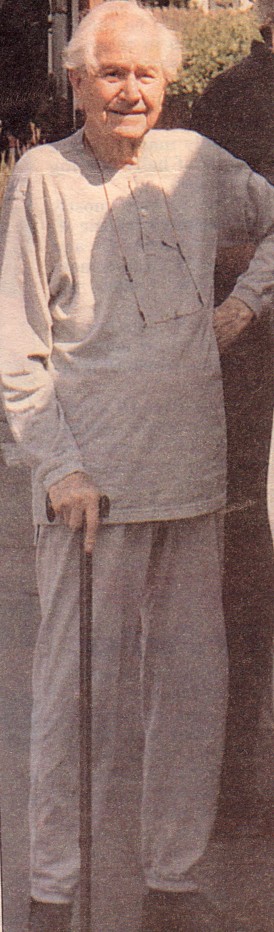
Fourth, this shows that money and material possessions really do not satisfy! As Paul puts it, “We have brought nothing into the world, so we cannot take anything out of it either” (1 Timothy 6:7). We really can find no ultimate happiness in getting or having money or riches of any kind. We don’t know what Young’s bank account looked like, but it must have been much in light of the many years he was in movies and TV. Our research says that at the time of his death, he was only worth $5 million. (https://www.celebritynetworth.com/richest-celebrities/actors/robert-young-net-worth/)
Yet, this didn’t bring lasting happiness. His many acting credits (something over a hundred) was not really worth it. He died at 91 and had to face his Creator as everyone else does (see Ecclesiastes 12:10-12); 2 Corinthians 5:10). This should instruct us—or, actually, warn us not to “store up for” ourselves “treasures on earth” (Matthew 5:19-21). Our Lord asks, “What does it profit a man to gain the whole world, and forfeit his soul?” (Mark 8:36; cf. vv. 34-37). Will we learn from Young’s sad life?
Fifth, let us do God’s will while we can. We know that there is no indication that Young made any attempt to repent of his sinful life or his attempt to commit suicide. There is no record of his desire to make things right with God or others. There is no written or spoken record of his desire to repent of his relationship to the opposite sex or his efforts to make amends with his wife, or repent of his decades of shameful drunkenness. There is no indication that he repented of his worldly movies, his TV dramas, his worldliness, or anything else. But apparently (from the records we have seen) he was like most other people in living his life with little or no thought of eternity or his relationship to God. This is a warning to us to do something while we can and while we have life. We don’t know what tomorrow will bring (James 4:14-15).

Sixth, Young apparently didn’t profess Christianity of any kind. He adhered to Mind Science, which would be a form of Gnostic religion. Sadly, this would mean that Young didn’t know the joys and blessings of knowing God through Jesus Christ our Savior.
Mind Science is a very sad and depressing religion for it gives no real hope now and no hope for the future. That is, unless one were to find some sort of deceptive religious hope that is not based on truth. Only Jesus Christ can give such hope. As the Lord has clearly said, “I am the way, and the truth, and the life; no one comes to the Father but through Me” (John 14:6). Sadly, Young did not know God through Jesus, thus he missed out on the way to real escape from the evils of life and the blessings of life in Christ.
How about you and me? Will we take these lessons to heart and learn from them? Will we determine now to live our lives for Jesus Christ and prepare for eternity? As Paul has said:
The love of Christ controls us, having concluded this, that one died for all, therefore all died; and He died for all, so that they who live might no longer live for themselves, but for Him who died and rose again on their behalf” (2 Corinthians 5:14-15).
Several Sources Consulted:
https://www.nytimes.com/1998/07/23/arts/robert-young-of-father-knows-best-dies-at-91.html
https://en.wikipedia.org/wiki/Robert_Young_(actor)#Personal_life_and_death


 You can reach us via e-mail
at the following address:
You can reach us via e-mail
at the following address: